Category: Ayurveda

  • Ayurvedic Ingredients for Skin – Top 10 Science-Backed Herbs

    Ayurvedic Ingredients for Skin – Top 10 Science-Backed Herbs

    Introduction

    According to a 2023 clinical review by Karger Publishers, topical curcumin significantly improves skin health because of its strong antioxidant, anti-inflammatory, and antimicrobial effects. Source: Karger Publishers (2023)

    This scientific evidence forms the base for many of the most effective ayurvedic ingredients for skin used today.

    Ayurveda blends ancient herbal wisdom with modern dermatology to create science-backed Ayurvedic skincare solutions, giving us natural yet clinically supported ways to brighten the skin, calm irritation, and strengthen the skin barrier.

    For over 30 years, Sage Herbal has followed this same philosophy by combining trusted Ayurvedic herbs with research-driven formulation.

    In this guide, you will learn how these top Ayurvedic ingredients work, why science supports them, and how they naturally enhance skin glow and overall skin health.

    What Makes Ayurvedic Ingredients for Skin Effective?

    Ayurvedic herbs are rich in antioxidants, anti-inflammatory plant actives, and natural nutrients that support long-term skin health. These herbs contain natural actives that help strengthen the skin barrier, protect the skin from everyday damage, and prevent dullness, acne, and pigmentation.

    This powerful synergy of Ayurveda and dermatology-backed research makes these Ayurvedic ingredients for skin ideal for everyday skincare. Sage Herbal’s R&D team follows this dual approach by validating traditional herbs through modern testing methods, ensuring both safety and effectiveness.

    What Ayurveda Says About Skin Types?

    Ayurveda explains skin health through the balance of Vata, Pitta, and Kapha.

    Vata Skin

    • Dry, thin, and easily dehydrated.
    • Imbalance leads to roughness, fine lines, and dullness.
    • Calming herbs: Aloe vera, Ashwagandha, Licorice.

    Pitta Skin

    • Sensitive, combination type, may show redness.
    • Imbalance causes inflammation, pigmentation, and acne.
    • Cooling herbs: Manjistha, Sandalwood, Neem.

    Kapha Skin

    • Oily, thick, and congestion-prone.
    • Imbalance causes acne, uneven tone, and whiteheads.
    • Clarifying herbs: Turmeric, Neem, Gotu Kola.

    When doshas become imbalanced, the skin loses radiance and becomes prone to dullness, breakouts, and pigmentation. Identifying your dosha helps you choose the right ayurvedic ingredients for skin, ensuring targeted and effective care.

    Signs Your Skin Needs Ayurvedic Ingredients

    You may benefit from ayurvedic ingredients for skin and ayurvedic herbs for glowing skin if you notice:

    • Dullness or loss of glow
    • Uneven pigmentation
    • Redness, burning, or sensitivity
    • Frequent acne or stress-related breakouts
    • Fine lines or loss of firmness
    • Irritation after chemical-heavy skincare

    Herbs gently heal, nourish, and correct imbalances without harsh effects, making them a safer option when your skin feels overwhelmed or stressed.

    Top 10 Ayurvedic Ingredients for Skin and Glowing Skin Benefits
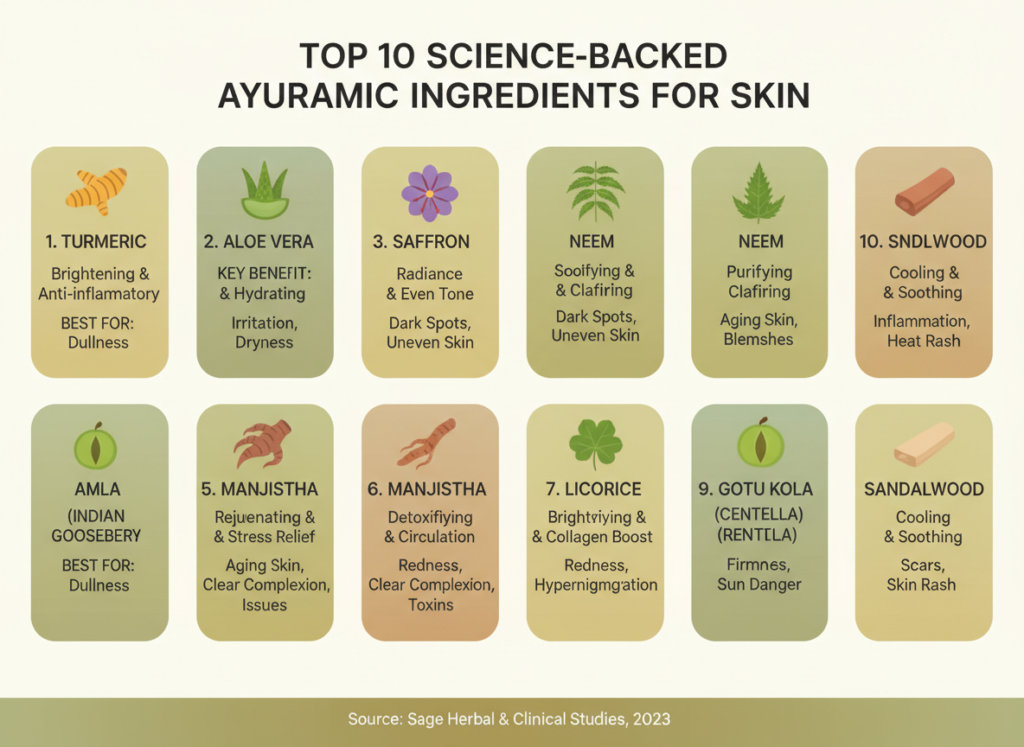
    Infographic showing top 10 science-backed Ayurvedic ingredients for skin, including turmeric, aloe vera, saffron, neem, manjistha, amla, licorice, gotu kola, and sandalwood with their key skin benefits.

    Here are the top ayurvedic ingredients for skin and other herbal skincare ingredients, their benefits, and usage tips supported by traditional wisdom and modern research.

    1. Turmeric (Haridra) – Anti-inflammatory + Brightening

    Turmeric is one of the most powerful ayurvedic ingredients for skin and one of the most trusted ayurvedic herbs for glowing skin because of curcumin(a plant compound in turmeric), which fights inflammation and reduces pigmentation.

    Science says: Curcumin shows antioxidant, anti-inflammatory, and antimicrobial benefits (Karger, 2023).

    Best for: All skin types, dullness, pigmentation
    How to use: Face masks, serums, gentle cleansers
    Extra guidance: Use 1–2x weekly or in low-strength daily serums and always patch tests.

    You can also explore our Best Ayurvedic skin care products – Sage Herbals for deeper nourishment and glow.

    2. Aloe Vera – Hydration + Healing

    Aloe vera deeply hydrates and supports barrier repair. Its cooling nature makes it ideal for sensitive and acne-prone skin.

    Benefits:

    • Reduces redness
    • Speeds healing
    • Soothes irritation
      Use in: Gels, moisturizers, calming serums
      Extra guidance: Safe for daily use, especially after sun exposure or irritation.

    3. Saffron (Kesar) – Radiance-Boosting Herb

    Saffron has been traditionally used for improving complexion and glow.

    Science-backed benefits: Brightening, tone correction, antioxidant support
    Ideal for: Dullness, uneven tone
    Use: Infused oils, night serums
    Extra guidance: Best used at night for gradual radiance improvement.

    4. Neem – Clarifying + Acne Control

    Neem contains nimbidin, a well-studied antibacterial compound.

    Benefits:

    • Controls acne-causing bacteria
    • Reduces inflammation
    • Balances oil production

      Best for: Oily, acne-prone skin
      Use: Cleansers, spot gels, purifying masks
      Extra guidance: Use 2–3× weekly; avoid over-dryness by pairing with a hydrating gel.

    5. Ashwagandha – Powerful Anti-Aging Herb

    Ashwagandha is an adaptogen that reduces oxidative stress, a major cause of premature aging.

    Benefits:

    • Boosts firmness
    • Reduces fine lines
    • Supports skin recovery
      Use: Serums, creams, facial oils
      Extra guidance: Ideal for nighttime routines for deeper repair.

    6. Manjistha – Pigmentation & Detox Herb

    Manjistha is a key herb used in many skincare formulas because it helps clear internal heat and supports the natural detox process, which can reduce pigmentation.

    Why it works: Helps even skin tone and reduce dark spots
    Best for: Pigmentation-prone skin
    Use: Brightening creams, serums,and  herbal masks
    Extra guidance: Works best when used consistently 3–4× weekly.

    7. Licorice (Yashtimadhu) – Natural Brightener

    Licorice contains glabridin(a licorice compound that helps reduce pigment), a compound that helps reduce melanin activity.

    Benefits:

    • Brightens
    • Reduces tanning
    • Calms sensitivity
      Use: Serums, soothing creams
      Extra guidance: Great for sensitive skin; can be used daily in low concentration.

    8. Amla – Vitamin C Powerhouse

    Amla is a natural source of Vitamin C, which boosts collagen and radiance.

    Benefits:

    • Brightens
    • Improves firmness
    • Strengthens the skin barrier
      Use: Serums, rejuvenating masks
      Extra guidance: Best paired with sunscreen in the morning routine.

    9. Gotu Kola (Centella) – Skin Barrier Support

    Gotu Kola supports collagen development and helps fade scars.

    Benefits:

    • Reduces fine lines
    • Strengthens skin barrier
    • Smoothens texture
      Use: Serums, creams, barrier repair formulations
      Extra guidance: Ideal for daily use, especially for sensitive or damaged skin barriers.

    10. Sandalwood – Cooling + Glow Enhancing

    Sandalwood is revered for its calming and complexion-enhancing effects.

    Benefits:

    • Reduces tanning
    • Controls inflammation
    • Improves natural glow
      Use: Calming packs, cleansers, serums
      Extra guidance: Always patch test if you have sensitive skin.

    How Ayurvedic Ingredients for Skin Work Together for Better Results?

    When combined thoughtfully, these ayurvedic ingredients for skin offer:

    • Deep antioxidant protection
    • Brightening and pigmentation control
    • Acne reduction and balanced oil levels
    • Collagen support and firming
    • A stronger, healthier skin barrier
    • Reduced sensitivity and inflammation

    This is why these herbs work well together in Ayurvedic skincare, which focuses on blend-based formulations rather than single herbs. The combined actives deliver broader and more effective skin benefits.

    Ayurvedic Ingredients for Skin: Suitability by Skin Type

    Here is a quick skin-type guide to help you choose the most suitable Ayurvedic ingredients for skin based on your specific concerns.

    Skin TypeBest Ayurvedic IngredientsWhy They Work
    Dry SkinAloe vera, Ashwagandha, LicoriceHydration, barrier repair, calming
    Oily SkinTurmeric, Neem, Gotu KolaClarifies pores, controls excess oil
    Acne-Prone SkinNeem, Turmeric, Aloe veraAntibacterial, reduces inflammation
    Pigmentation-Prone SkinManjistha, Licorice, SaffronBrightening, melanin control
    Aging SkinAshwagandha, Amla, Gotu KolaAnti-oxidant protection, firming
    Sensitive SkinAloe vera, Sandalwood, LicoriceCooling, soothing, barrier support

    This simple guide helps you identify the right ayurvedic ingredients for skin based on your unique skin needs.

    How to Use Ayurvedic Ingredients for Skin Safely and Effectively?

    Ayurvedic herbs are powerful yet gentle, but correct usage ensures maximum benefit from ayurvedic ingredients for skin.

    1. Always Patch Test
      Even natural herbs can trigger sensitivity. Apply a small amount on the inner arm and wait 24 hours.
    2. Start With 2–3 Ingredients
      Avoid mixing too many herbs at once. Ayurveda works best with balanced blends.
    3. Use Consistently
      Skin takes around a month to renew, and herbal actives work best when used regularly over time.
    4. Safe Combinations
      Turmeric + Aloe vera → Brightening + calming
      Manjistha + Licorice → Pigmentation control
      Gotu Kola + Amla → Anti-aging + collagen support
    5. Avoid These Combinations
      Strong exfoliants with turmeric
      Neem with retinoids (can cause dryness)
      Citrus oils on sensitive skin

    Following these guidelines ensures Ayurvedic herbs support your skin effectively without irritation.

    Common Myths About Ayurvedic Ingredients for Skin

    Myth 1: Ayurveda is slow
    Fact: Herbal activities start working from day one, especially antioxidant and anti-inflammatory compounds. Visible improvements appear in 2–4 weeks.

    Myth 2: Natural products don’t need patch testing
    Fact: Even natural extracts can irritate sensitive skin. Patch testing is essential.

    Myth 3: Ayurveda has no scientific support
    Fact: Many clinical studies, including the 2023 Karger review on curcumin, confirm the skin benefits of Ayurvedic herbs.

    Myth 4: One herb suits everyone
    Fact: Ayurveda is personalized. Skin type, season, and dosha determine which herbs work best.

    Myth 5: More ingredients give better results
    Fact: Balanced formulations work better than overloaded recipes.

    Ayurvedic skincare works best when tradition, science, and the right method come together in your routine.

    Science-Backed Benefits of Ayurvedic Ingredients for Skin

    When used consistently, the top ayurvedic ingredients for skin and science-backed Ayurvedic skincare routines offer benefits supported by both Ayurveda and dermatology:

    Brighter and more even skin tone:
    Saffron, Licorice, and Manjistha help reduce melanin activity.

    Reduced pigmentation and dark spots:
    Clinically supported herbs like Manjistha and curcumin help reduce dark spots and uneven pigmentation.

    Calmer acne and inflammation:
    Neem, turmeric, and aloe vera fight bacteria and soothe irritation.

    Stronger and healthier skin barrier:
    Gotu Kola and aloe vera improve moisture retention and resilience.

    Youthful firmness and reduced fine lines:
    Amla and Ashwagandha support collagen production.

    Better hydration and long-term glow:
    Herbal ingredients nourish the skin deeply without overwhelming it.

    Ayurvedic skincare works because it addresses both internal causes and external symptoms naturally.

    Why Choose Sage Herbal for Ayurvedic Ingredients for Skin Care?

    Sage Herbal stands out because it blends classical Ayurvedic wisdom with clinical research, ensuring safe, effective, and ethically crafted products.

    1. Over 30 Years of Dermatology-Backed Expertise
    Founded by the renowned Dr. P. N. Behl, Sage Herbal combines deep Ayurvedic knowledge with medical understanding.

    2. Clinically Tested Herbal Formulations
    Every formulation undergoes research, stability checks, and safety testing.

    3. GMP, ISO, and FSSAI-Certified Manufacturing
    These certifications ensure purity, quality, and global compliance.

    4. Strong R&D Foundation
    An in-house research team validates herbs using scientific methods.

    5. Ingredient Transparency
    Only pure, authentic herbs are sourced responsibly.

    This credibility makes Sage Herbal a trusted choice for anyone seeking natural, science-backed skincare solutions crafted with integrity.

    Frequently Asked Questions

    1. Which Ayurvedic ingredient is best for glowing skin?

    Turmeric, saffron, and manjistha are considered the most effective glow-enhancing herbs.

    2. Are Ayurvedic ingredients safe for all skin types?

    Yes, they are generally safe, but patch testing is important, especially for sensitive skin.

    3. What is the most powerful Ayurvedic herb for anti-aging?

    Amla and Ashwagandha are top choices because they support collagen and help reduce fine lines.

    4. How do I use Ayurvedic ingredients for skin at home?

    You can apply them as serums, face masks, cleansers, or infused oils based on your skin type.

    Conclusion

    Ayurveda and science-backed Ayurvedic skincare together offer powerful, time-tested solutions for skin health, now supported by modern clinical research. The best ayurvedic ingredients for skin brighten, calm, protect, and rejuvenate when used correctly and consistently.

    With Sage Herbal’s science-backed formulations, you get the purity of traditional herbs combined with the trust of dermatology. Each product reflects Dr. P. N. Behl’s legacy of bringing together Ayurvedic wisdom and modern research.

    To simplify your routine, explore Sage Herbals’ clinically tested, Ayurveda-based Skin Care formulations that support long-term skin health and natural radiance.

    Please subscribe to our social channels for updates related to Ayurvedic skincare, research-based herbs, and wellness tips.

    InstagramSage Herbals

    FacebookSage Herbals 

    YouTube: Sage Herbals

    LinkedIn: Sage Herbals Pvt.Ltd.
  • A Guide to Selecting the Best Third-Party Ayurvedic Manufacturer

    A Guide to Selecting the Best Third-Party Ayurvedic Manufacturer

    Imagine this: you have a brilliant Ayurvedic product idea—maybe it’s a turmeric-based skin balm or a stress-relief tonic inspired by your grandmother’s remedies. You’ve visualised the packaging, nailed the branding, and maybe even have a name that gives you goosebumps.
    But then comes the question, “Who’s going to make this for me?”
    This is where most entrepreneurs get stuck. Because turning your Ayurvedic idea into a high-quality, compliant, market-ready product requires more than herbs and hope—it needs the right manufacturing partner.

    Why Mass-Produced Ayurveda Doesn’t Work

    Ayurveda is not a trend. It’s a 5,000-year-old science that deserves reverence and responsibility. Unfortunately, many Ayurvedic manufacturers today operate like fast-fashion factories—producing generic products with no soul, often cutting corners on ingredients, ethics, and science.

    What Sets a Good Ayurvedic Manufacturer Apart

    If you’re serious about quality, transparency, and long-term success, here’s what you should look for:

    1. Real Ayurvedic Knowledge, Not Just Machinery

    Most manufacturers have equipment. But how many have in-house Ayurvedic doctors, formulation experts, and researchers who understand the healing properties of herbs beyond just mixing powders? Every product is developed through a clinical-meets-traditional lens, balancing ancient knowledge with modern science.

    2. Custom Formulations That Tell Your Story

    Don’t just slap your label on someone else’s product. Your brand should have a voice and a story—and that begins with a custom formulation. Whether you want to create a vegan digestive syrup or an anti-aging elixir, Sage Herbals helps you design it from the ground up, keeping your brand DNA intact. They even help refine ancient recipes to meet modern regulatory standards, which is huge when selling in the EU, US, or UAE.

    3. Certifications Are Non-Negotiable

    GMP, ISO, AYUSH approvals, COAs, lab test reports, third-party audits—if your manufacturer shrugs at these terms, run. Sage Herbals is GMP & ISO 9001:2015 certified, with a reputation built over 30+ years. Their products are exported globally, which means they’re already compliant with international safety, hygiene, and efficacy standards.

    4. One Roof, All Services

    Many third-party manufacturers offer production but leave you hanging on packaging, branding, or documentation. Sage does it differently. They offer a complete 360° service:

    • Packaging design
    • Labeling
    • Documentation
    • Regulatory clearances
    • Logistics
    • Private labelling
    • Export support
      Basically, they become your Ayurvedic backend team, without the overhead.

    Also Read: The Future of Private Label Herbal Products

    Why Sage Herbals Stands Out

    Their Roots Are Real

    They’ve been in the Ayurvedic ecosystem since the 90s—not just riding the green wave that began a few years ago. Their journey started with a mission to bring pure, affordable, and effective Ayurvedic products to the world—and that passion still runs deep.

    They Believe in Lab Tests, Not Just Labels

    Sage ensures every batch goes through rigorous testing—for microbial safety, heavy metal contamination, shelf-life, and consistency. That’s the kind of science you want behind your Ayurvedic promises.

    Ethically and Globally Conscious

    From cruelty-free testing to eco-conscious packaging and herb sourcing from sustainable farms, Sage walks the talk on responsibility. Plus, they already ship to multiple continents—so they know how to make your product travel-ready.

    The Ultimate Checklist to Vet Your Ayurvedic Manufacturing Partner

    CriteriaWhat to Look ForSage Herbals?
    Experience10+ years in Ayurvedic formulationYes (30+ years)
    CertificationsGMP, ISO, AYUSH, COAsYes
    Custom FormulationsYes, with R&D supportYes
    Export ReadinessInternational packaging & complianceYes
    Clean Label PromiseFree from parabens, SLS, syntheticsYes
    One-Stop ServicesManufacturing + branding + documentationYes
    Ingredient TransparencyFull traceability & testingYes

    Red Flags to Watch Out For

    • Manufacturers who won’t share ingredient sourcing info
    • Factories without GMP or AYUSH clearance
    • No support for compliance paperwork (especially for international markets)
    • MOQ promises that seem “too good to be true” (they often are)

    The Human Side of Ayurvedic Manufacturing

    You’re not building just another wellness brand. You’re building something with heart, purpose, and healing. Your manufacturer should match that frequency. Sage Herbals isn’t just a vendor—they’re a collaborator, a problem solver, a co-visionary. They don’t just create products—they help craft stories, solve real-world health issues, and respect the wisdom of Ayurveda every step of the way.

    The Ayurvedic space is growing, yes—but so is the competition. What will set you apart is not just what you offer, but how it’s made, and who helps you make it. Choosing a third-party manufacturer is not just a business decision—it’s a legacy decision. If you’re looking for a team that blends science with soul, look no further than Sage Herbals.

    Ready to Create Your Own Ayurvedic Line?

    Your idea deserves more than a manufacturer—it deserves a partner that sees its value, understands its cultural and medicinal significance, and has the infrastructure to bring it to life responsibly. In a world filled with shortcuts, Sage Herbals offers the long game: purity, credibility, and a legacy of healing.

    So if you’re ready to build a brand that people trust—not just today but for generations—start by choosing a manufacturer that honors your vision as much as you do. Sage Herbals might just be that perfect beginning.

  • How to Start Your Own Ayurvedic Brand with Third-Party Manufacturing? Step By Steps

    How to Start Your Own Ayurvedic Brand with Third-Party Manufacturing? Step By Steps

    In a post-pandemic world where health has taken center stage, Ayurveda is not just a trend—it’s a lifestyle revival. Globally, people are returning to traditional roots, craving natural wellness solutions free from chemicals and side effects. The Ayurvedic product market is projected to surpass $21 billion by 2028, with a growing demand in immunity-boosting, skincare, haircare, and digestive wellness.

    That’s not just a business opportunity—it’s a movement. The rising awareness around preventive healthcare, immunity building, and holistic living makes Ayurveda more relevant than ever. Increased internet penetration, teleconsultation, and the rise of eCommerce have made Ayurvedic products more accessible than ever before.

    If you’ve ever dreamt of launching your own Ayurvedic brand but felt overwhelmed by the process, third-party manufacturing is your golden gateway. And if you’re looking for a partner who understands purity, performance, and purpose, Sage Herbals is your answer.

    What is Third-Party Manufacturing in Ayurveda?

    Third-party (or contract) manufacturing is when you collaborate with an experienced manufacturer to produce Ayurvedic goods under your brand name. You focus on building your brand and distribution—while your manufacturing partner handles formulation, production, testing, and packaging.

    This model is especially useful in Ayurveda due to the complexity of herbal sourcing, traditional formulations, and strict quality control standards that require specialized knowledge and certifications. It eliminates the heavy burden of setting up your own infrastructure and gives you access to a well-oiled manufacturing process.

    You also gain access to industry expertise, premium ingredients, innovative formulations, and the flexibility to create a unique product range.

    Why Third-Party Manufacturing is the Smart Choice

    Launching your Ayurvedic brand through third-party manufacturing comes with powerful advantages:

    • Low initial investment and minimal risk: No need to buy land or install machinery.
    • Speed to market: Get your products out faster without setup delays.
    • No manufacturing hassles: Leave compliance, quality control, and production to the experts.
    • Wide product portfolio: Access a range of ready-to-brand or customized formulations.
    • Scalability: Start small and scale quickly based on market response.
    • Expert guidance: Benefit from R&D and Ayurvedic expertise from your manufacturing partner.

    It’s the most efficient route for entrepreneurs, wellness coaches, doctors, influencers, or FMCG investors looking to enter the Ayurvedic space with credibility and speed. Looking for Reliable Third Party Ayurvedic Manufacturers? Partner with Sage Herbals – Your Trusted Choice for Quality Herbal Products!

    Third-Party Manufacturing vs In-House Manufacturing: A Quick Comparison

    FeatureThird-Party ManufacturingIn-House Manufacturing
    Setup CostLowHigh
    Time to MarketFastSlow
    R&D SupportProvided by partnerRequires dedicated team
    Regulatory ComplianceHandled by partnerYour responsibility
    Product VarietyExtensiveLimited (initially)
    StaffingNo need for internal teamRequires full team setup
    Capital RiskMinimalHigh

    Third-party manufacturing lets you launch fast, smart, and with expert backing. In-house manufacturing may give you complete control, but it’s capital-intensive, slower, and riskier—especially for startups.

    Why Sage Herbals Should Be Your Go-To Partner

    With 20+ years of legacy in Ayurvedic and herbal product manufacturing, Sage Herbals is one of India’s most trusted, transparent, and technologically advanced partners for third-party manufacturing.

    Key Benefits of Partnering with Sage Herbals:

    • GMP & ISO 9001:2015 Certified Facilities
    • In-House R&D and Custom Formulation Development
    • Ayurvedic and Herbal Product Range of 100+ SKUs
    • Complete Private Labeling & Packaging Support
    • Trusted by 150+ Global and Indian Brands
    • Dedicated Export Support & Documentation
    • Stringent Quality Control and Lab Testing
    • Ethical Sourcing and Eco-Friendly Manufacturing

    Sage Herbals is known for its commitment to sustainability, innovation, and quality. Whether you’re entering the domestic market or planning to export globally, their infrastructure is equipped to support both.

    Also Read: Third-party Ayurvedic Products Manufacturer In Delhi NCR

    Step-by-Step Guide to Launching Your Ayurvedic Brand with Sage Herbals

    Step 1: Discover Your Niche & Audience

    Success in Ayurveda begins with clarity. Identify your target audience and their specific wellness needs:

    • Urban professionals seeking immunity and stress relief
    • Women focused on skincare and hormonal balance
    • Elderly users dealing with joint health or digestion
    • Youth interested in hair care and natural cosmetics

    Conduct surveys, research market trends, and align your products with Ayurvedic principles and customer pain points.

    Step 2: Choose Your Product Range

    Sage Herbals offers:

    • 100+ ready-to-brand Ayurvedic & herbal products
    • Custom formulations based on your market demands
    • Product categories like oils, capsules, balms, syrups, powders, skincare, teas, juices, gels, and more

    You can also request trending products such as Vitamin C serums, anti-hair fall kits, or herbal pain relief balms. Sage also helps with season-specific product recommendations, such as summer cooling tonics or winter immunity boosters.

    Step 3: Create a Unique Brand Identity

    Stand out with thoughtful branding. With Sage, you get:

    • Label and packaging design services
    • AYUSH, FSSAI, and legal compliance support
    • Guidance on logo, brand story, tagline, and product messaging

    Your brand identity should reflect your mission, values, and promise to the customer. Be authentic, culturally aware, and build emotional connect through storytelling.

    Step 4: Legal Formalities & Documentation

    With Sage, the burden of paperwork is significantly reduced. You just need to:

    • Register your company and brand
    • Secure a trademark for exclusivity
    • Align with Sage’s certifications for AYUSH, GMP, and ISO compliance
    • Understand export documentation if you plan to go global

    They provide expert guidance and ready templates for most documentation processes.

    Step 5: Production & Quality Assurance

    Once your product range is finalized:

    • Sage initiates production in GMP-certified labs using high-grade raw materials
    • Every batch undergoes microbial, heavy metal, and stability testing
    • You receive detailed documentation and batch records

    Sage ensures scientific precision, traditional authenticity, and regulatory compliance. You can also request samples for trial and feedback before full production.

    Step 6: Packaging, Delivery & Launch

    Your products are delivered shelf-ready. You can launch through:

    • Your eCommerce website and social media shops
    • Marketplaces like Amazon, Flipkart, Nykaa
    • Offline channels like pharmacies, clinics, Ayurveda centers, and modern retail

    Sage helps you customize packaging for different regions, SKUs, and seasons. You can opt for sustainable, travel-size, or premium packaging options.

    Sage Exclusive: Custom Formulations That Set You Apart

    Want to create a signature product line? Sage’s in-house R&D lab offers:

    • Bespoke herbal formulations
    • Ingredient research and validation
    • Clinical trials for proof of efficacy (on request)

    Popular Custom Formulation Ideas:

    • Ashwagandha Capsules for stress & energy
    • Herbal Under Eye Serum with manjistha and vetiver
    • Digestive Teas with triphala, fennel, and ginger
    • Hair fall control oils with bhringraj, amla, and neem
    • Immunity powders with giloy, tulsi, and cinnamon

    These tailor-made offerings help your brand stand out in a crowded market.

    Go Global: Export-Ready Ayurvedic Products

    Sage Herbals is not just a domestic giant. It also facilitates global expansion:

    • Export-compliant packaging and labelling
    • International certifications (as per region)
    • Expertise in documentation for Europe, USA, UAE, and Asia-Pacific
    • Long-standing partnerships with global wellness retailers and importers

    With Sage, you can access international markets without worrying about complex regulatory hurdles. They also support international branding, logistics, and documentation.

    Also Read: How to Start Your Own Cosmetic Brand: A Guide

    Marketing Tips to Grow Your Ayurvedic Brand

    A great product is only half the battle. Here are some Marketing Ideas for Herbal Products that makes your brand visible and desirable:

    1. Develop an Authentic Brand Story

    Highlight your inspiration, mission, and commitment to Ayurveda. Build content around real stories, founder journeys, and purpose-driven messaging.

    2. Collaborate with Influencers and Experts

    Partner with Ayurvedic practitioners, dermatologists, wellness bloggers, and fitness coaches. User-generated content builds trust and reach. Host wellness webinars and Ayurvedic masterclasses.

    3. Leverage SEO and Content Marketing

    Publish educational blogs, wellness guides, video explainers, and product demos. Rank for keywords like “best Ayurvedic immunity booster” or “natural hair oil.” Use email marketing and newsletters for retention.

    4. Diversify Sales Channels

    Sell via:

    • D2C Website
    • Amazon/Flipkart
    • Wellness Portals like 1mg, Netmeds
    • Offline distribution in health stores and spas
    • Pop-up stores, exhibitions, and Ayurveda fests

    5. Use Customer Reviews and Packaging as Trust Builders

    Invest in testimonials, before-and-after photos, and informative, eco-conscious packaging to elevate brand trust. Offer loyalty programs and first-time buyer discounts.

    Your Ayurvedic Brand Starts Here

    The global wellness wave has created the perfect opportunity for aspiring entrepreneurs to make their mark in Ayurveda. Whether you’re a passionate healer, a doctor, a wellness coach, or an investor, the Ayurvedic space is open for innovation and growth.

    But to truly succeed, you need a partner who brings more than just manufacturing—you need a visionary collaborator who understands your journey. Sage Herbals is that partner. With unmatched experience, regulatory expertise, world-class infrastructure, and a passion for wellness, they are your ideal launchpad.

    Take the leap. Let Sage Herbals help you bring your Ayurvedic brand to life—authentic, trusted, and globally ready.

  • 10+ Herbs for Hair Growth and Scalp Health

    10+ Herbs for Hair Growth and Scalp Health

    Having healthy, luscious hair is a desire shared by many. However, factors such as stress, pollution, and improper hair care practices can lead to hair issues like hair loss, dandruff, and scalp irritation. Fortunately, nature provides us with a plethora of herbs that have been used for centuries to promote healthy hair growth and maintain scalp health. These natural solutions not only nourish the hair but also address underlying scalp issues that may contribute to hair loss and poor hair quality.  In this blog, we will explore some of the most effective herbs for achieving strong, vibrant hair and a nourished scalp, as well as some of the most powerful herbs for hair growth and scalp health, their benefits, and how to use them effectively.

    What is the Role of Herbs in Hair and Scalp Health?

    Herbs contain potent bioactive compounds, such as antioxidants, vitamins, and essential oils that stimulate hair follicles, improve circulation, reduce inflammation, and strengthen hair strands. Many herbs also possess antibacterial and antifungal properties that help keep the scalp clean and free from infections. By incorporating herbs into your hair care routine, you can achieve stronger, shinier, and healthier hair naturally.

    Best Herbs for Hair Growth and Scalp Health

    1. Aloe Vera

    Aloe vera is widely known for its soothing and moisturizing properties. It contains enzymes that help repair dead skin cells on the scalp, reducing dandruff and promoting a healthy scalp environment for hair growth.

    Benefits:

    • Deeply hydrates and soothes the scalp
    • Reduces dandruff and itchiness
    • Strengthens hair and prevents breakage

    How to Use: Apply fresh aloe vera gel directly to the scalp, leave it on for 30 minutes, and rinse with lukewarm water. It can also be mixed with coconut oil or castor oil for added nourishment.

    If you’re looking for best Aloe Vera Shampoo then Sage Herbal provide the best Aloe Vera Shampoo which acts as natural conditioning agent that restores the hair’s sheen, luster & shine.

    2. Bhringraj (Eclipta Alba) – The King of Hair

    Bhringraj is an ancient Ayurvedic herb known as the “king of herbs” for hair growth. It helps in strengthening hair roots, preventing hair fall, and delaying premature graying.

    Bhringraj is highly regarded for its ability to promote hair growth and prevent hair loss. It strengthens hair roots, reduces hair thinning, and revitalizes the scalp. Bhringraj oil, extracted from its leaves, is widely used as a natural hair tonic and is known to restore hair’s natural colour, shine, and thickness. 

    Benefits:

    • Stimulates hair growth and strengthens roots
    • Prevents premature graying
    • Reduces hair fall and promotes thicker hair

    How to Use: Bhringraj oil can be massaged onto the scalp before shampooing. Bhringraj powder can also be mixed with water or yogurt to create a nourishing hair mask.

    3. Amla (Indian Gooseberry) – The Hair Tonic

    Amla is packed with vitamin C and antioxidants that boost collagen production, strengthen hair follicles, and improve scalp circulation. Amla is considered the powerhouse herb for hair care in Ayurveda. Rich in vitamin C and antioxidants, it strengthens hair follicles, promotes hair growth, and prevents premature greying. Amla also conditions the scalp, prevents dandruff, and adds shine to the hair. It can be used in various forms, including powdered form, oil infusion, or as an ingredient in hair masks.

    Benefits:

    • Prevents hair loss and strengthens roots
    • Enhances hair shine and thickness
    • Reduces dandruff and scalp irritation

    How to Use: Amla oil can be massaged into the scalp for deep nourishment. Amla powder can also be mixed with coconut oil or yogurt and applied as a hair mask.

    Also Read: Top Hair Care Tips for Gorgeous, Healthy Hair

    4. Fenugreek (Methi)- The Strengthening Herb

    Fenugreek seeds are rich in protein, nicotinic acid,  vitamins, minerals, and lecithin, which help repair damaged hair and stimulate new growth, which is beneficial for hair health. They strengthen hair roots, prevent hair loss, and add shine and volume to the hair. Fenugreek also soothes the scalp, reduces dandruff, and moisturizes dry hair. A fenugreek seed paste or fenugreek-infused oil can be applied to the hair and scalp for best results.

    Benefits:

    • Strengthens hair shafts and prevents breakage
    • Reduces dandruff and scalp inflammation
    • Adds shine and softness to hair

    How to Use: Soak fenugreek seeds overnight, grind them into a paste, and apply to the scalp for 30-40 minutes before rinsing. Fenugreek oil can also be used as a pre-wash treatment.

    5. Lavender

    Lavender is a pretty purple flower with a calming smell. But it’s not just for looks or fragrance—it is really good for your hair and scalp too. It helps grow new hair, keeps your scalp clean, and makes you feel relaxed. Sometimes, stress can make your hair fall. Lavender helps with that too.

    Benefits:

    • Helps hair grow faster and thicker
    • Improves blood flow to the scalp, which wakes up hair roots
    • Reduces hair fall caused by stress or tension
    • Fights bacteria and dandruff
    • Soothes dry, itchy, or flaky scalp
    • Makes hair smell fresh and lovely

    How to Use:
    Mix 3–4 drops of lavender essential oil with 2 tablespoons of coconut oil or almond oil. Massage it gently into your scalp in small circles. Leave it for 30 to 60 minutes. Wash with a mild shampoo. You can also mix a few drops into your shampoo or conditioner for daily use.

    6. Ginseng

    Ginseng is a root used in natural medicine. It gives energy—not just to the body, but also to your hair roots. It wakes up weak or resting hair follicles and helps them grow again. It also helps your scalp stay strong and healthy.

    Benefits:

    • Makes hair roots stronger
    • Helps grow new and thicker hair
    • Reduces hair thinning and hair fall
    • Protects the scalp from damage
    • Keeps the scalp healthy by increasing blood flow
    • Adds volume and shine to your hair

    How to Use:
    Mix 1 teaspoon of ginseng powder with warm coconut oil to make a paste. Apply it on your scalp. Massage gently and leave it on for 30–40 minutes. Wash with a gentle shampoo. You can also use ginseng-infused oil, tonics, or hair masks.

    7. Peppermint

    Peppermint is a cool, minty herb that smells very refreshing. It gives a cooling feeling when applied to the skin or scalp. This cooling effect increases blood flow to your hair roots, helping them grow faster and stay healthy. It also helps clean your scalp and reduce extra oil or dandruff.

    Benefits:

    • Boosts blood flow, which helps hair grow
    • Refreshes the scalp and removes build-up
    • Reduces itching, dryness, and flakiness
    • Keeps the scalp clean and healthy
    • Makes your hair feel cool and fresh
    • Fights dandruff and extra oil

    How to Use:
    Mix 2–3 drops of peppermint essential oil with a tablespoon of coconut or olive oil. Massage into your scalp. Leave it on for 15–20 minutes. Wash with lukewarm water and mild shampoo. You can also buy peppermint shampoos or hair sprays.

    8. Rosemary – The Hair Thickener

    Rosemary is a herb known for its stimulating properties that promote hair growth and thickness. It improves blood circulation to the scalp, strengthens hair follicles, and prevents hair thinning. Rosemary also has antioxidant properties that protect the hair from damage caused by free radicals. Using rosemary-infused oil or adding rosemary essential oil to your hair care routine can contribute to healthier and thicker hair.

    Rosemary is a powerful herb known for stimulating blood circulation in the scalp, which helps in promoting hair growth and reducing hair thinning.

    Benefits:

    • Encourages hair growth and prevents hair loss
    • Improves scalp circulation
    • Strengthens hair follicles

    How to Use: Rosemary essential oil can be diluted with a carrier oil and massaged into the scalp. A rosemary-infused hair rinse can also be made by boiling fresh rosemary leaves in water.

    Looking for best Hair Fall Treatment Shampoo then Sage Herbal provide the ultimate skin treatment for the scalp.

    9. Hibiscus – The Flower of Hair Care

    Hibiscus is a popular herb known for its rejuvenating properties. It nourishes the hair follicles, promotes hair growth, and helps prevent hair breakage. Hibiscus also balances the scalp’s pH level, soothes the scalp, and reduces dandruff. Using hibiscus flowers, leaves, or oil infusions can lead to healthier, more vibrant hair. Hibiscus flowers and leaves are rich in amino acids and vitamins that promote hair growth, prevent dryness, and condition the scalp.

    Benefits:

    • Improve blood circulation to the scalp
    • Stimulates hair growth and reduces hair fall
    • Prevents dandruff and scalp infections
    • Adds shine and softness to hair

    How to Use: Hibiscus flowers and leaves can be ground into a paste with water or coconut oil and applied to the scalp. Hibiscus tea can also be used as a hair rinse.

    10. Neem – The Scalp Savior

    Neem is a powerful herb with antibacterial, antifungal, and anti-inflammatory properties, making it an excellent remedy for scalp issues. It helps combat dandruff, scalp infections, and inflammation. Neem also stimulates blood circulation to the scalp, promoting healthy hair growth. Neem oil or neem-infused hair products can effectively address scalp concerns and maintain overall scalp health. 

    Benefits:

    • Treats dandruff and scalp infections
    • Promotes healthy hair growth
    • Controls excess oil production

    How to Use: Neem oil can be applied directly to the scalp or mixed with a carrier oil. Neem powder can also be used in hair masks.

    11. Brahmi – The Nourisher

    Brahmi, known for its cognitive benefits, is also an excellent herb for hair growth. It stimulates the hair follicles, enhances blood circulation to the scalp, and helps in reducing hair fall. Brahmi also nourishes the scalp, prevents dryness, and soothes irritation. It is commonly used in the form of oil or as an ingredient in hair care products.

    Benefits:

    • Mix essential oils or herbal-infused oils with a carrier oil and use them for scalp massages.
    • Create nourishing hair masks using powdered herbs mixed with water, yogurt, or coconut oil.
    • Use herbal teas or decoctions as a final rinse after shampooing to enhance scalp health.
    • Incorporate herbal teas or supplements to promote hair health from within.

    Conclusion

    Herbs provide a natural and effective way to improve hair growth and scalp health. By incorporating these powerful botanical ingredients into your routine, you can strengthen your hair, prevent damage, and maintain a healthy scalp without relying on chemical-based products. Herbs have long been valued for their medicinal properties, and when it comes to hair care, they offer a natural and effective solution. Amla, Brahmi, Bhringraj, Hibiscus, Neem, Fenugreek, and Rosemary are just a few examples of the remarkable Herbs for Hair Growth and maintain scalp health. Incorporating these herbs into your hair care routine, whether in the form of oils, hair masks, or herbal rinses, can help address various hair concerns and restore the natural vitality of your hair. Whether through oils, masks, or rinses, consistent use of these herbs can lead to visibly stronger, healthier, and shinier hair.

    Discover top-quality private labelling & third-party manufacturing with Sage Herbals. Customize skincare, haircare, and wellness products under your brand. Start today!

  • Ayurvedic Beauty Secrets: Top Beauty Tips To Pass Down Through Generations

    Ayurvedic Beauty Secrets: Top Beauty Tips To Pass Down Through Generations

    In the pursuit of beauty, many of us are turning towards ancient wisdom to find holistic and natural solutions. One such ancient tradition is Ayurveda, a system of medicine that originated in India thousands of years ago. Ayurveda not only focuses on physical well-being but also emphasizes the importance of inner balance and harmony. Passed down through generations, Ayurvedic beauty secrets offer timeless wisdom for achieving radiant skin, lustrous hair, and overall well-being. In this blog, we will dive into the rich heritage of Ayurvedic beauty tips, exploring traditional practices, natural ingredients, and holistic approaches that have stood the test of time.               

    Top Ayurveda Beauty Tips                 

    1. Understanding Ayurveda: The Foundation of Beauty

    To truly appreciate Ayurvedic beauty secrets, it’s important to grasp the underlying principles of Ayurveda. Ayurveda views beauty as a reflection of inner health and balance. It recognizes three primary doshas—Vata, Pitta, and Kapha—which represent different energies within the body. Each dosha has unique characteristics and requires specific care. Understanding your dominant dosha can help personalize your beauty routine and address any imbalances.

    2. Ayurvedic Skincare Rituals: Nurturing the Skin

    Ayurveda offers a range of skincare rituals that cleanse, nourish, and rejuvenate the skin. One such ritual is Abhyanga, a self-massage technique using warm herbal oils to promote circulation, detoxification, and deep relaxation. Ubtan, a traditional herbal paste, is another Ayurvedic secret for glowing skin. It combines potent herbs, grains, and spices to exfoliate, brighten, and moisturize the skin.

    If you’re lookingremium body care solutions with Sage Herbals’ private labeling & 3rd party manufacturing services. Customize skincare products with natural ingredients!

    3. Ayurvedic Herbal Ingredients: Nature’s Bounty

    Ayurvedic beauty secrets rely heavily on natural ingredients that are known for their therapeutic properties. Some commonly used herbs include turmeric, neem, aloe vera, sandalwood, and rose. Turmeric, with its anti-inflammatory and antioxidant properties, is often used in face masks to promote a clear and radiant complexion. Neem acts as a powerful antibacterial agent, while aloe vera soothes and hydrates the skin. Sandalwood and rose are cherished for their cooling and rejuvenating properties.

    4. Inner Beauty, Outer Glow: Ayurvedic Dietary Practices

    Ayurveda emphasizes the connection between diet and beauty. According to this ancient tradition, consuming a balanced diet that aligns with your dosha can promote healthy skin and hair. Incorporating fresh fruits and vegetables, whole grains, healthy fats, and adequate hydration into your daily routine can have a profound impact on your external appearance.

    5. Ayurvedic Haircare Secrets: Nurturing the Tress                                                               

     Ayurveda recognizes the significance of healthy hair as a vital aspect of beauty. Ayurvedic haircare rituals involve nourishing the scalp and using natural ingredients to strengthen and revitalize the hair. Regular oiling with Ayurvedic herbal oils, such as Brahmi, Bhringraj, or Amla, can help improve hair texture, promote growth, and prevent dryness. Herbal hair masks and rinses using ingredients like hibiscus, fenugreek, and amla are also popular Ayurvedic remedies for healthy, lustrous locks.

    6. Holistic Self-Care: Mind, Body, and Spirit

     In Ayurveda, beauty is not limited to external appearance but is seen as an expression of overall well-being. The practice of self-care extends beyond skincare and haircare routines to include mindful practices like yoga, meditation, and pranayama (breathing exercises).

    Also Read: How Ayurvedic Tablets Can Help You Live A Healthier Life?

    Final Thought

    Ayurvedic beauty secrets carry with them the wisdom of generations, offering a holistic and natural approach to beauty and well-being. By understanding and embracing the principles of Ayurveda, we can unlock the transformative power of ancient remedies, rituals, and ingredients. From skincare and haircare rituals to mindful self-care practices, Ayurveda guides us towards inner balance, radiance, and harmony with nature. Embracing these timeless beauty secrets allows us to tap into the wisdom of the past and experience the transformative power of Ayurveda in our modern lives.

    Discover top-quality private labelling & third-party manufacturing with Sage Herbals. Customize skincare, haircare, and wellness products under your brand. Start today!


  • Third-party Ayurvedic Products Manufacturer In Delhi NCR

    Third-party Ayurvedic Products Manufacturer In Delhi NCR

    Ayurvedic Products are the finest chance for those wishing to partner with Ayurvedic medicine manufacturers in Delhi NCR.

    Sage Herbals, third-party manufacturing of ayurvedic products in Delhi comes to mind when we think of the Best ayurvedic medicine third-party manufacturing in Delhi. Moreover, it is imperative to have support from a genuine and bona fide manufacturer of ayurvedic medicines in this economic sector that is expanding quickly. As a result, Neutragen is the greatest because we have developed some outstanding qualities.

    Sage Herbals is the leading ayurvedic medicine manufacturer in Delhi, with cutting-edge technology and the greatest staff in the industry. We can create enormous amounts of items rapidly. Moreover, our creation plant has all of the expected government accreditations and endorsements. Because the complete production unit is located in a duty-free zone, the entire process is substantially more economical.

    Sage herbals provide various benefits with top-notch quality in Delhi. Our specialty is in providing prompt delivery on all the manufacturing products. While the products have been tested by the team of professional’s scientists, our herbal products are 100% tested free from side effects. As the best Ayurvedic products manufacturer in Delhi we are with a clear vision to provide the best inline products in the market, we also are certain of providing the value to our consumers.

    Sage Herbals, a burgeoning name in Ayurvedic product manufacturing, is committed to providing a wide range of Ayurvedic formulations. As top ayurvedic medicine manufacturers in Delhi, our mission is to make high-quality herbal remedies accessible to people throughout the nation, and we achieve this by utilizing only the finest ingredients sourced from reputable suppliers. With a diligent team of quality controllers overseeing every aspect of production, we ensure the excellence of our Ayurvedic offerings.

    Our administrations in this field are remarkable as we plan the items exactly per the client’s requests. Right from initiation to its marking, we cover each angle to meet the ideal necessities as third-party makers of ayurvedic items.

    Their main contributions and creation services include domestically sourced personal care products, medical supplies, hair care products, and much more. As the top independent producers of ayurvedic medicine manufacturers in Delhi NCR, they are aware of their responsibilities and the kind of effort required to get the most out of the use of herbal products.

    Delhi, the country’s capital, has a prospering people of in excess of 30 million. Delhi, India’s second-richest city, has enormous potential for any ayurvedic enterprise. If you own a herbal business in Delhi, you should consider ayurvedic medicine third-party manufacturing in Delhi. Because it has numerous advantages over traditional production methods.

    Demand for the Ayurveda in Delhi

    Nowadays, people are more focusing on Ready-made things and the need for pure and organic stuff is speedily inclining. However, it is approved that the demand for Ayurveda is emerging into positive results. And, the demand is successfully increasing in the market people taking consideration. Moreover, the Ayurveda market for the register of CAGR is 12 percent and will probably increase to 16 in 2025.

    • The need for the Ayurveda in the urban as well in the rural is both the same, people seeking for the best product of Ayurveda.
    • The future for the Ayurveda seems to flourish and it looks like the demand for this will be an increase in the future.
    • Today’s of the entrepreneurs seeking the customer with effective ayurvedic medications.
    • The ultimate leads to high market demand for Ayurveda products are increased worldwide too.
  • How Ayurvedic Tablets Can Help You Live A Healthier Life?

    How Ayurvedic Tablets Can Help You Live A Healthier Life?

    “Health is a state of complete physical, mental and social well-being and not merely an absence of disease or infirmity.”Ayurveda is an ancient Indian system of medicine, that emphasizes on prevention of body ailments rather than simply relieving pathological problems or symptoms. It helps the patient to understand the benefits of knowing their body and mind and to live in an intimate relationship with nature. Ayurveda is a gift of Gods to mankind which was communicated to the saints and sages of India through deep meditation. Vedas have topics on health and the use of various herbs  Ayurvedic knowledge originated in India more than 5,000 years ago and is often called the “Mother of All Healing.”It stems from the ancient Vedic culture and was taught for many thousands of years in an oral tradition from accomplished masters to their disciples.

    What is Ayurveda?

    The word “Ayurveda” is derived from Sanskrit and means “science of life.” In Ayurveda, there’s an underlying belief that everything in life is connected. Because of this, general health and wellness rely on achieving balance and harmony.

    When a person is imbalanced or stressed, they’re likely to develop disease. Ayurveda focuses on implementing lifestyle interventions and natural treatments, therapies, and remedies to provide balance in your physical body, mind, spirit, and the world around you.

    Every individual is unique, and Ayurveda defines a person’s specific constitution or Prakriti. According to Ayurveda, these prakriti determine your physical, psychological, behavioral, and immunological traits. Different constitutions respond to different treatments, so what works for you might not work for someone else.

    Three doshas

    According to Ayurvedic philosophy, each person’s constitution is made up of three doshas: vata, pitta and Kapha. You can think of doshas as energy types: each of these doshas is believed to dictate your emotional strengths and weaknesses, the foods your body needs and wants, the exercises that might work the best for you, and more. Ayurvedic practitioners seek to help you find a balance among all three doshas. When the doshas are out of balance, illness occurs. The Ayurvedic practitioner uses nutrition, stress management, exercise, and sometimes herbs to help a person regain health and balance.

    “Like increases like, so if you have trouble getting up and getting moving, you probably don’t want to do a restorative yoga practice in the morning if you need to build energy and get going,” says Warren. “Instead, you might want to do some sun salutations where you’re not holding postures for very long.”

    Here’s what you need to know about each dosha.

    Vata dosha

    According to Ayurveda philosophy, vata controls the flow of movement in your body and mind. Vata determines your flexibility, the movement of your muscles and joints, your blood flow and the way you breathe.

    If you’re dominant in vata, you’re creative, flexible and quick to action. As you’re snappy, you also have the downside of worrying or feeling anxious when you have too much vata. For someone with excessive vata, an Ayurvedic practitioner may suggest grounding techniques like sticking to a regular sleep-eat schedule, meditation, and relaxation. “A walking meditation is a lovely meditation for someone that feels like they can’t sit still, especially if it’s in the morning as the sun is coming up,” says Warren.

    Pitta dosha

    Pitta is loosely translated as “fire,” so think of this energy type as something that consumes other things. Pitta, in Ayurvedic theory, is responsible for controlling digestion, hormones and metabolism.

    If you’re dominant in pitta, you tend to be dominant in leadership, competitive, strong-willed, confident and focused. In Ayurveda, when your pitta is off balance, you might be quick to anger or excitement, make rash decisions or participate in self-destructive behavior. Pitta imbalance also presents itself in inflammation, rashes, skin conditions like eczema or acne, and digestive issues like irritable bowel syndrome, diarrhea and more. To balance pitta, Ayurvedic practitioners might suggest participating in cool, calming activities. Eating cooler foods that help with inflammation are also possible suggestions.

    Kapha dosha

    Kapha is the element that holds everything together, from your cells to your muscles, bones and ligaments. The densest of the three doshas, kapha is known for endurance and lubrication.

    If you’re dominant in kapha, you may be comfortable sticking to a routine. Emotionally, you like to set expectations and hold to them. Kapha-dominant individuals are loyal, nurturing and dependent on others. But when imbalanced, kapha can cause excessive fatigue, weight gain, swelling, disinterest in new activities and inability to let things go. To combat an imbalance of kapha, essential olis may be helpful. Individuals are steered away from comfort foods to lighter fare like fruits and vegetables in smaller portions throughout the day. Increasing physical activity to get blood flowing is also a good practice.

    Ayurvedic Medicine in the form of Tablets:

    The range of forms of medicines in Ayurveda is wide and varied. When choosing the right form of tablet, you need to consider the individual characteristics of the person.

    For digestive disorders, kvats and vati are more suitable, as they contain herbs that help improve the gastrointestinal tract. They are taken in short courses, as they can damage internal tissues.

    After the patient has completed a short course of kwata and vati, the doctor can prescribe taila and grikhta. The body will already be completely cleansed, digestion will be normalized, and the perception of more effective medicines will be positive. When prescribing treatment, an Ayurvedic specialist always determines what type of person the patient belongs to.

    • The Kapha type benefited by taking powders.
    • Oil-based preparations are suitable for the Vata type.
    • If a person has a predominantly pitta type, then vati and kwata are prescribed.
    • In case of frequent dehydration of the body, decoctions are recommended. Herbal mixtures are prescribed for tone, and if nutritious fats are needed, oil-based mixtures are suitable.

    Now you have a basic idea of how to improve your life with Ayurveda. However it is quite difficult to independently select a medicine without special knowledge, so it is recommended to consult a certified Ayurveda specialist and follow his recommendations.

    References: