Category: Sage Herbals Blog

  • Third Party Manufacturing vs In-House: Cost Comparison

    Third Party Manufacturing vs In-House: Cost Comparison

    Are Indian brands underestimating the real cost of manufacturing before their first sale?

    Setting up an Ayurvedic manufacturing unit in India generally requires a major investment before your first product reaches the market, often ranging from ₹50 lakh to ₹5 crore or more depending on scale, because the facility, machinery, and compliance costs add up quickly (Source: Industry setup estimates).

    When brands evaluate Third Party Manufacturing vs In-House Manufacturing, both options demand investment. The real difference lies in when the money is spent, how much capital is committed upfront, and the level of risk the brand takes on..

    Most online comparisons reduce this decision to basic numbers, but manufacturing choices don’t work that way. They depend on your business stage, compliance responsibility, and production planning, all tied into one critical decision.

    This article breaks down real costs, hidden risks, and practical trade-offs so you can decide based on facts, not assumptions.

    Third Party Manufacturing vs In-House Manufacturing: What It Actually Means in India ?

    When brands talk about manufacturing, they usually refer to two models: third party manufacturing and in-house manufacturing. Many people misunderstand these terms and assume manufacturing is only about machines and production, but in regulated industries like Ayurveda, supplements, and cosmetics, the meaning goes much deeper.

    Third party manufacturing means a brand gets its products made by an approved external manufacturer. The manufacturer already has the facility, machinery, AYUSH and FSSAI approvals, and compliance systems in place. They handle production, testing, documentation, audits, and regulatory processes, while the brand focuses on formulation decisions, packaging, marketing, and sales.

    In-house manufacturing means the brand sets up and runs its own manufacturing unit. The brand manages everything directly, including facility setup, machinery, AYUSH licenses, FSSAI approvals, pollution permissions, fire NOCs, labor compliance, audits, inspections, and documentation. Along with production, the brand also maintains full-time teams such as production managers, quality controllers, warehouse staff, and maintenance technicians.

    Both models involve structured processes, strict compliance, and ongoing operational responsibility. The difference lies in who owns and manages the manufacturing infrastructure and regulatory obligations on a day-to-day basis.

    Why Choose Third Party Manufacturing Over In-House Manufacturing?

    When brands evaluate Third Party Manufacturing vs In-House Manufacturing, the decision usually comes down to capital exposure, operational responsibility, and flexibility. In-house manufacturing demands heavy upfront investment and long-term fixed costs, while third party manufacturing allows brands to start, test, and scale production without building infrastructure.

    The real cost difference between both models is clearly explained below.

    Cost Breakdown: In-House Manufacturing

    Cost AreaIn-House Manufacturing Details
    Land or Long-Term Lease₹50 lakh to ₹2 crore for a compliant manufacturing space. Industrial zones near metros cost more, while remote areas reduce rent but increase logistics challenges.
    Machinery & Validation₹1.5–3 crore for mixing tanks, filling lines, labeling machines, and testing equipment, plus ₹20–40 lakh for installation, calibration, and initial validation batches.
    Compliance & CertificationAYUSH license, GMP certification, FSSAI, ISO (if required), pollution clearance, and fire safety approvals together cost ₹15–30 lakh and take 6–12 months. Renewals and audits add ongoing expenses.
    StaffingA team of 10–15 people across production, quality, packing, and maintenance costs ₹25–40 lakh annually. Skilled GMP professionals earn 30–40% higher salaries than non-regulated manufacturing roles.
    Utilities, Downtime & RejectsPower, water, fuel, and waste management add ₹3–6 lakh per month. Maintenance downtime, festive shutdowns, and learning-phase rejects further increase costs.
    Total First-Year Cost₹3–8 crore depending on scale and location. Setting up an Ayurvedic manufacturing unit in India requires accounting for every layer, not just machinery.

    What Third Party Manufacturing Really Covers?

    Third party manufacturing does not remove costs. It shifts them from upfront investment to batch-based spending.

    Instead of investing in land, machinery, and licenses, brands pay per batch. The manufacturer absorbs capital expenditure, compliance management, staffing, and facility maintenance. Brands focus on formulation direction, packaging decisions, marketing, distribution, and sales.

    What still stays with the brand includes formulation development unless provided by the manufacturer, packaging design, label approvals, marketing material, and inventory planning. Minimum order quantities can lock working capital if demand forecasting is inaccurate.

    Third party manufacturing in India appears cost-effective upfront because manufacturers have already invested crores in setup. They recover these costs by serving multiple clients at high capacity, allowing brands to benefit from economies of scale without carrying the full risk. The trade-off is operational dependency on the manufacturer’s timelines, quality systems, and available capacity.

    For brands that want this model to work smoothly, choosing the right manufacturing partner matters. Companies like Sage Herbals Pvt. Ltd. support brands with GMP-certified facilities, formulation development, testing, and compliance handling, making third party manufacturing easier to manage without building in-house infrastructure.

    Cost Breakdown: Third Party Manufacturing in India

    Cost AreaThird Party Manufacturing Details
    Per-Unit Pricing₹8–50 per unit for Ayurvedic syrups, tablets, or powders, depending on formulation complexity, pack size, and order volume. Higher MOQs reduce per-unit cost.
    MOQ RequirementsMinimum batch sizes usually range from 5,000–10,000 units per SKU. Slow-moving products can lead to cash lock-in and expiry risk.
    Packaging & Formulation ChargesCustom formulation development costs ₹50,000–2 lakh. Packaging components like bottles, cartons, and labels add ₹2–10 per unit.
    Compliance CostsTesting, documentation, GMP maintenance, and regulatory compliance are built into per-unit pricing, removing the need for an in-house regulatory team.
    Total Cost for 10,000 Units₹2–5 lakh for a mid-complexity Ayurvedic product, including packaging and testing. Scaling up lowers per-unit cost, while smaller volumes reduce negotiation power.

    Because in-house manufacturing demands heavy upfront investment, long compliance timelines, fixed staffing costs, and ongoing operational risk, most brands find it capital-intensive and inflexible in the early stages.

    Third party manufacturing avoids these burdens by offering batch-wise costs, built-in compliance, and faster scalability. For this reason, third party manufacturing is the smarter and more practical choice for most growing brands.

    This cost structure works best when manufacturers already operate at scale. Established third party manufacturers like Sage Herbals Pvt. Ltd. spread compliance, testing, and operational costs across multiple brands, which helps keep per-unit pricing predictable and compliant for growing businesses.

    Side-by-Side Cost Reality: In-House vs Third Party Manufacturing

    Here’s a quick comparison of the factors that truly matter when evaluating third party vs in-house manufacturing.

    Key Decision Factors

    • Capital Lock-In: In-house manufacturing requires ₹3–8 crore upfront, while third party manufacturing only needs ₹2–10 lakh per SKU batch as working capital. For early-stage or bootstrapped brands, this gap can decide survival.
    • Time to Market: In-house setup takes 8–18 months due to approvals, hiring, and validation. Third party manufacturing can start in 30–90 days, making speed a clear advantage in D2C markets.
    • Compliance Risk: With in-house manufacturing, you handle every audit, renewal, and inspection. A single lapse can stop production. In third party manufacturing, the compliance burden stays with the manufacturer.
    • Unit Economics at Low Volume: At around 10,000 units per month, third party manufacturing remains cost-efficient. In-house manufacturing starts making sense only beyond 1 lakh units per month with stable demand.

    The contract manufacturing vs own factory decision should be driven by your current scale and risk capacity. If volumes are uncertain and capital needs protection, third party manufacturing is the practical choice. In-house manufacturing becomes relevant only when demand is stable, predictable, and large enough to absorb fixed costs.

    When In-House Manufacturing Is a Practical Choice?

    In-house manufacturing works best when a brand operates at a stable and predictable scale. If monthly volumes consistently cross 50,000 units across multiple SKUs, fixed costs like staff, utilities, and compliance get absorbed more efficiently.

    It also suits brands with finalized formulations and minimal product changes. Running production internally gives better control over recipes and processes, but frequent experimentation can increase cost and complexity. In-house setups are more effective when customization or unique processes are critical to the product.

    This model requires strong regulatory understanding. Teams must manage AYUSH, GMP, and FSSAI compliance independently. Without this maturity, audits and renewals can become operational risks. For brands with steady demand and long-term category focus, in-house manufacturing can offer control, but it demands commitment and discipline.

    When Third Party Manufacturing Is the Right Choice?

    Third party manufacturing suits brands that need speed, flexibility, and capital protection in the early and growth stages. It allows products to reach the market within weeks instead of months, making it easier to test demand without locking large funds into infrastructure.

    This model limits operational exposure. Compliance management, audits, and quality systems stay with experienced manufacturers, reducing risk during uncertain demand phases. Production can scale up or down based on sales without adding fixed costs like staff or machinery.

    Third party manufacturing also works well when brands explore new SKUs or categories. It keeps operations lean and focused on brand building and distribution. While it offers less direct control, it provides a practical balance between growth and financial discipline.

    For brands exploring this route, working with an experienced manufacturer reduces early-stage risk. Sage Herbals Pvt. Ltd. helps startups and D2C brands launch Ayurvedic products faster by managing compliance, testing, and production under one roof.

    Decision Framework: How Brands Make the Right Manufacturing Choice?
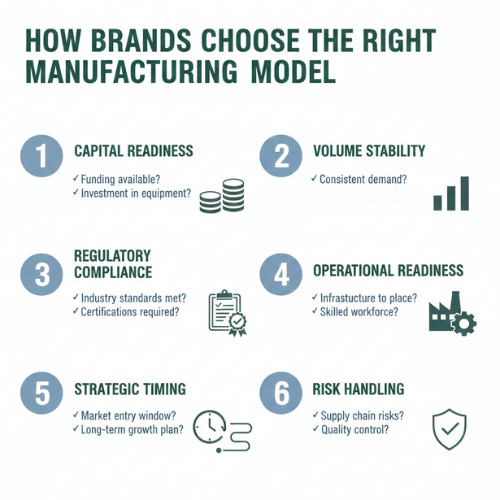
    Decision framework explaining third party manufacturing vs in-house manufacturing based on capital readiness, volume stability, compliance, operations, timing, and risk.

    Use this checklist to decide between third party manufacturing vs in-house manufacturing. Answer these questions based on where your business stands today. This works only if you answer based on facts, not plans.

    1. Capital & Financial Readiness

    • Do you have ₹5+ crore available without disturbing daily business?
    • Can your business run for 12–18 months without revenue from a new factory?
    • Is your working capital enough for inventory, salaries, and utilities during setup?

    2. Volume & Demand Stability

    • Are you selling 30,000+ units every month across SKUs?
    • Do you have at least 12 months of stable or growing sales data?
    • Do your top 3 SKUs bring 70% or more of total revenue?

    3. Regulatory & Compliance Readiness

    • Do you have in-house knowledge of AYUSH, FSSAI, and GMP?
    • Can your team handle audits, paperwork, and license renewals on its own?
    • Have you managed compliance in any regulated industry before?

    4. Operational Readiness

    • Are your formulations final with very few changes?
    • Do you have access to trained GMP production and quality staff?
    • Can you manage machine maintenance, calibration, and downtime?

    5. Strategic Timing

    • Is speed less important than long-term margin control right now?
    • Are you committed to this category for the next 5 years?
    • Do your processes really need in-house control?

    6. Risk Handling Ability

    • Can your business survive a 6-month production stop?
    • Can you afford idle factory costs if demand drops?
    • Do you have backup plans for quality or machine failures?

    How to Read Your Score?

    • 0–4 YES answers
      → Third party manufacturing is the safer and smarter option.
    • 5–8 YES answers
      → You’re in between. A hybrid or phased approach may work.
    • 9+ YES answers
      → In-house manufacturing can be considered with detailed planning.

    Why Choose Sage Herbals?

    When evaluating third party manufacturing vs in-house, execution matters as much as strategy. Sage Herbals Pvt. Ltd. offers GMP, ISO, and FSSAI-certified third party manufacturing with end-to-end support, from formulation and lab testing to production and customized packaging. This allows brands to scale without locking capital into factories or compliance teams.

    If you’re planning your next move in third party manufacturing vs in-house, connecting with Sage Herbals can help you choose the right path with clarity and confidence.

    Frequently Asked Questions

    1. Which is cheaper for startups: third party manufacturing vs in-house manufacturing?

    For startups and early-stage brands, third party manufacturing vs in-house manufacturing clearly favors third party manufacturing. In-house manufacturing needs ₹3–8 crore upfront and ongoing fixed costs, while third party manufacturing works on batch-wise pricing. This makes third party manufacturing more affordable, flexible, and safer when demand is still uncertain.

    2. When should a brand switch from third party manufacturing to in-house manufacturing?

    In the third party manufacturing vs in-house manufacturing decision, switching to in-house makes sense only when monthly volumes are stable above 50,000 units, formulations are finalized, and the brand can manage AYUSH, GMP, and FSSAI compliance independently. Until then, third party manufacturing helps brands scale without financial pressure.

    3. Why do brands choose Sage Herbals for third party manufacturing instead of in-house manufacturing?

    When comparing third party manufacturing vs in-house manufacturing, many brands choose Sage Herbals Pvt. Ltd. because it removes the need for heavy investment in factories, staff, and compliance. Sage Herbals provides GMP, ISO, and FSSAI-certified manufacturing, formulation support, testing, and customized packaging, allowing brands to launch and scale without building infrastructure.

    4. Is third party manufacturing safe and compliant compared to in-house manufacturing?

    Yes. In the third party manufacturing vs in-house manufacturing debate, third party manufacturing is safe when done with a certified partner. Companies like Sage Herbals Pvt. Ltd. follow strict GMP processes, regular audits, and regulatory testing. This often makes third party manufacturing more reliable than running an in-house setup without deep compliance experience.

    Conclusion

    The real decision in third party manufacturing vs in-house manufacturing is not about control or ambition. It is about timing, capital protection, and operational readiness. In-house manufacturing suits brands with stable demand, strong compliance capability, and long-term volume certainty. For most startups and growing brands, third party manufacturing offers lower risk, faster market entry, and flexible scaling.

    Choosing the right model at the right stage protects cash flow, reduces compliance pressure, and allows brands to focus on product, distribution, and growth. Manufacturing success comes from alignment with business reality, not from building infrastructure too early.

    Third party manufacturing vs in-house manufacturing for Ayurvedic and herbal brand development

    Disclaimer

    The cost figures, comparisons, and examples mentioned in this article are indicative industry estimates provided for informational and educational purposes only. Actual manufacturing costs may vary based on formulation complexity, order volume, packaging requirements, regulatory approvals, and market conditions. This article does not represent fixed pricing or commercial terms of Sage Herbals Pvt. Ltd. For accurate quotations, project feasibility, or manufacturing discussions, brands are advised to consult directly with the manufacturer.

    Please subscribe to our social channels for updates related to Ayurvedic skincare, research-based herbs, and wellness tips.

    InstagramSage Herbals

    FacebookSage Herbals

    YouTubeSage Herbals

    LinkedInSage Herbals Pvt.Ltd.

  • Is Third-Party Ayurvedic Manufacturing Profitable in 2026?

    Is Third-Party Ayurvedic Manufacturing Profitable in 2026?

    Introduction

    The Ayurvedic market in India is growing steadily. In 2025, its market size reached around $19.29 billion, and it is expected to grow at nearly 19% every year till 2030, as reported by Mordor Intelligence. This growth looks attractive, but there is another side that many people ignore. Every year, thousands of Ayurvedic brands enter the market through third-party manufacturing, but only a few remain profitable in the long run.

    Ayurvedic third-party manufacturing can be profitable in 2026, but only for businesses that clearly understand the full cost picture, realistic growth needs, and legal rules involved. Brands that ignore these factors often end up with unsold stock and falling profit margins.

    This article explains the financial and day-to-day business side of third-party manufacturing, based on more than 30 years of manufacturing experience. It focuses on where profits are really made, which costs are often missed, and why basic business planning matters more than product formula alone.

    Many brands choose established ayurvedic third-party manufacturing companies like Sage Herbals for their years of experience and GMP-certified facilities.

    What Third-Party Ayurvedic Manufacturing Actually Means in 2026?

    ayurvedic third party manufacturing process showing ayurvedic product filling in GMP facility

    Third-party manufacturing, also known as contract manufacturing, is a setup in which the brand owner handles branding, product formulation, and sales. In contrast, a licensed manufacturer handles production, quality testing, and legal compliance.

    This model is often shown as an easy way to enter the Ayurvedic industry. In reality, the responsibility does not reduce for the brand owner. Brand owners are still fully responsible for market placement, distribution planning, stock movement, and getting customers. The manufacturer manages factory operations, batch production, AYUSH licensing, and compliance under Schedule T of the Drugs and Cosmetics Rules.

    The biggest advantage of this model is that it saves the time and money needed to set up a manufacturing unit. However, it also creates dependency. The brand depends on the manufacturer for production timelines, batch quality consistency, and the ability to scale when demand increases.

    In third-party manufacturing of ayurvedic products, long-term success depends on choosing a manufacturer who follows GMP standards and keeps per-unit costs practical enough to match real market pricing.

    Is Ayurvedic Third-Party Manufacturing Profitable in 2026?

    Profitability depends on three main factors: product category, order volume, and distribution strength.

    For brands that start with small production runs of 500 to 1,000 units, profit margins usually range from 10% to 18% after including manufacturing, compliance, and packaging costs. At this stage, brands have very little control over pricing, and even small operational mistakes can quickly affect cash flow.

    When production increases to the 5,000-10,000 unit range, margins generally improve to around 20-30%. Brands at this level often have proven demand, better-negotiated manufacturing prices, and improved control over stock planning.

    Once volumes exceed 20,000 units per SKU, profit margins in ayurvedic third-party manufacturing can exceed 35%. Reaching this stage requires stronger working capital, reliable distribution channels, and steady sales movement.

    Although profit potential is real, it depends heavily on accurate planning. Brands usually face losses when they underestimate costs, overestimate demand, or work with manufacturing partners who fail to maintain consistent quality.

    Cost Breakdown You Cannot Ignore

    Manufacturing & Raw Material Costs

    Before calculating profits, it is important to understand the real costs in third-party ayurvedic manufacturing, especially at the manufacturing and raw-material levels.

    AspectExplanation
    Manufacturing cost rangeManufacturing costs depend on how complex the formulation is. Single-herb powders usually cost around ₹40 to ₹80 per unit, while multi-ingredient products made with standardized extracts can cost between ₹200 and ₹500 per unit.
    Raw material qualityRaw material quality directly affects how well the product works and whether customers buy it again. Very low prices often mean poor herb sourcing or weak extraction methods, which later reduce shelf life and customer trust.
    Additional manufacturing costsThe cost of third-party ayurvedic manufacturing also includes formulation wastage, usually between 3% and 7%, along with excipients and batch documentation. These costs must be added before deciding the final retail price.

    Compliance, Testing & Documentation Costs

    Compliance-related costs are often ignored during early planning. Every production batch requires a Certificate of Analysis, which includes lab tests for heavy metals, microbial contamination, and active ingredient checks. These tests usually cost between ₹5,000 and ₹15,000 per batch.

    Stability testing is required to confirm product shelf life and normally costs between ₹25,000 and ₹80,000 per SKU. GMP certification costs for manufacturers range from ₹50,000 to ₹5 lakh, as according to Factocert. These costs are not separate and are usually added to the overall manufacturing price.

    AYUSH licensing fees are ₹2,000 for generic products and ₹3,000 for up to 10 proprietary formulations, according to Register Karo. While manufacturers handle the licensing process, brands should still verify compliance status independently.

    Manufacturers offering very low prices often cut corners by reducing testing checks or using old certifications. When audits occur or quality issues arise, the impact falls directly on the brand, not the manufacturer.

    This is why many brands prefer ayurvedic third-party manufacturers in India, such as Sage Herbals, known for transparent testing and full access to documentation.

    Packaging, MOQ & Cash Lock-In

    Packaging involves more than just bottles and labels. It also includes cartons, printing plates, safety seals, and required information inserts. For many Ayurvedic supplements, packaging usually makes up 15% to 25% of the total product cost.

    Minimum Order Quantities can put pressure on early cash flow, especially during product launch. Most manufacturers ask for 3,000 to 10,000 units per SKU. When brands launch multiple variants together, it can lead to ₹5 lakh to ₹15 lakh being invested in inventory even before sales start.

    Custom packaging adds to the initial investment but also helps in building brand identity. Bottle molds and special printing plates may need ₹30,000 to ₹1.5 lakh in advance. While this cost is non-recoverable, it supports long-term branding and consistency.

    Inventory movement often takes more time than expected, especially in the early stages. When products take longer to sell, storage costs increase, and working capital stays locked. With proper demand planning and phased launches, this risk can be managed more effectively.

    Third-Party Manufacturing vs Own Factory

    Choosing between third-party manufacturing and an own factory depends on budget, control, and long-term growth plans.

    AspectThird-Party ManufacturingOwn Manufacturing Factory
    Initial InvestmentLow upfront investment, as brands pay only for productionHigh capital required, usually between ₹2 crore to ₹10 crore depending on scale and automation
    Setup TimeQuick to start, as infrastructure is already availableLong setup period, with commercial production starting after 18 to 24 months
    Breakeven PeriodBreakeven is possible within 6 to 18 months if sales are steadyBreakeven usually takes 3 to 5 years due to fixed costs
    Operating CostsPay-as-you-produce model helps manage expensesFixed costs continue even when production volume is low
    FlexibilityEasy to test multiple products without long-term commitmentLess flexible once infrastructure is set up
    Control LevelLimited control over production timelines and batch schedulingFull control over formulation changes, batch planning, and quality systems
    Risk LevelLower financial risk during early stagesHigher financial risk due to heavy capital investment
    Best Suited ForBrands still testing product-market fit and market demandBrands with stable demand and high, consistent volumes
    Scalability PointDepends on the manufacturer’s capacity and timelinesBecomes financially viable when volumes cross 50,000 units per month

    How to Choose the Right Ayurvedic Third-Party Manufacturing Company?

    Finding reliable ayurvedic third-party manufacturers in India needs proper evaluation, not just basic online research. A careful approach helps brands avoid long-term issues and build stable manufacturing partnerships. Warning signs should never be ignored, such as outdated GMP certificates, refusal of plant visits, lack of client references, or pricing that is far below market rates without explanation.

    Key evaluation points include a valid AYUSH license, Schedule T GMP compliance, proper batch production records, transparent quotations, access to testing labs, and clear terms for formulation confidentiality. During discussions, brands should ask practical questions about sourcing practices, production timelines, and past client experience. Clear processes matter more than sales talk when selecting an ayurvedic third-party manufacturing company.

    Why Brands Trust Sage Herbals as a Manufacturing Partner?

    At Sage Herbals, we work with brands that value compliance, clarity, and long-term growth. Since 1990, we have supported ayurvedic third-party manufacturing through GMP-certified facilities with a clear focus on documentation, process control, and consistent quality. Our capabilities cover formulation development, lab testing, and customized packaging, allowing brands to move from idea to market with confidence. Whether working with startups or scaling businesses, we bring structured manufacturing support that helps brands build reliable and compliant ayurvedic product lines.

    If you are planning to start or scale through ayurvedic third-party manufacturing, explore how Sage Herbals supports brands with compliant and well-structured manufacturing solutions. Connect with us to take the next step with clarity and confidence.

    Frequently Asked Questions

    1. Is ayurvedic third-party manufacturing profitable in 2026?

    Yes, ayurvedic third-party manufacturing becomes profitable in 2026 when brands manage costs correctly, plan realistic order volumes, and choose reliable manufacturing partners.

    2. How do I choose the right ayurvedic third-party manufacturing company in India?

    Choosing the right ayurvedic third-party manufacturing company in India depends on GMP compliance, AYUSH licensing, documentation clarity, and testing practices. Experienced manufacturers like Sage Herbals support brands with structured processes, transparent compliance, and end-to-end manufacturing capabilities.

    3. What is the difference between third-party manufacturing and owning an Ayurvedic factory?

    Third-party manufacturing of ayurvedic products allows brands to launch faster with lower investment, while owning a factory requires high capital and a longer setup time. Third-party manufacturing ayurvedic product models work best for brands testing demand, whereas their own factories suit businesses with stable, high-volume sales.

    4. Which brands benefit most from ayurvedic medicine third-party manufacturing?

    For brands exploring whether ayurvedic third-party manufacturing profitable models suit their goals, this approach works best for startups, D2C brands, and businesses expanding product lines without investing in manufacturing infrastructure. Companies like Sage Herbals support such brands with GMP-certified production, formulation support, and compliance-focused manufacturing, helping them scale in a structured and responsible way.

    Final Thoughts

    Third-party ayurvedic manufacturing can be profitable in 2026 for brands that move forward with realistic planning, enough working capital, and a clear focus on product quality.

    Market growth by itself does not guarantee success. Real profitability comes from understanding cost structures, choosing manufacturing partners carefully, and setting up strong distribution systems before investing heavily in inventory.

    Brands that follow this path benefit from clear financial planning, phased production orders, and manufacturers with reliable compliance records. The opportunity is real, but long-term results depend on disciplined execution from the very beginning.

    Please subscribe to our social channels for updates related to Ayurvedic skincare, research-based herbs, and wellness tips.

    InstagramSage Herbals

    FacebookSage Herbals

    YouTubeSage Herbals

    LinkedInSage Herbals Pvt.Ltd.

  • Top 5 Benefits of Employing an Ayurvedic Contract Manufacturer

    Top 5 Benefits of Employing an Ayurvedic Contract Manufacturer

    Want to launch Ayurvedic products without spending lakhs on factories and machines?
    Employing an Ayurvedic contract manufacturer offers numerous advantages for businesses looking to enter or expand in the herbal products market. As the demand for Ayurvedic solutions continues to rise, brands today need a smarter and faster way to bring quality products to market without operational stress.

    By partnering with a specialized Ayurvedic contract manufacturer, businesses can focus on branding, marketing, and distribution while experienced manufacturers handle production, quality control, and regulatory needs. This partnership not only reduces costs but also helps brands maintain consistent product quality and scale smoothly as demand grows.

    In this guide, you will clearly understand the top 5 benefits of employing an Ayurvedic contract manufacturer and how this approach can help your brand grow faster, smarter, and with less risk.

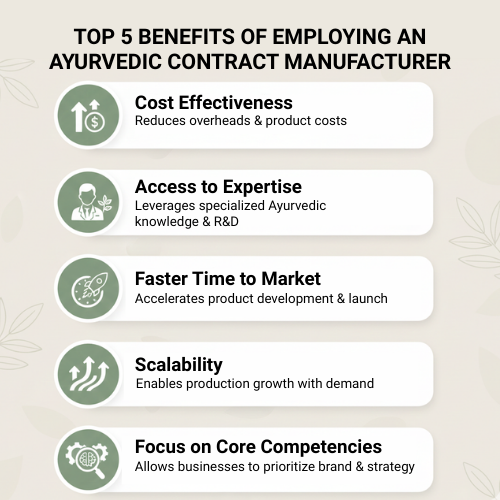
    Top 5 benefits of employing an Ayurvedic contract manufacturer including cost effectiveness, expertise, scalability, and faster time to market

    Employing an Ayurvedic contract manufacturer helps brands reduce manufacturing costs, access specialized Ayurvedic expertise, launch products faster, scale production with demand, and focus more on branding, marketing, and long-term business growth.

    1. Cost Effectiveness

    One of the most significant advantages of using an Ayurvedic contract manufacturer is cost savings. Establishing an in-house manufacturing facility requires substantial investment in equipment, raw materials, staffing, and compliance with regulatory standards. By outsourcing production, businesses can significantly reduce overhead costs associated with:

    • Infrastructure: Building and maintaining manufacturing facilities can be prohibitively expensive.
    • Labor Costs: Hiring skilled personnel, including technicians and quality control experts, adds to operational expenses.
    • Regulatory Compliance: Ensuring adherence to industry regulations involves additional costs related to licenses, inspections, and certifications.

    Contract manufacturers already have the necessary infrastructure and expertise in place, allowing brands to benefit from economies of scale. This means lower production costs can be passed on to consumers or reinvested into the business for growth initiatives.

    Example:

    For instance, a startup looking to launch a line of herbal supplements would face high initial costs if it attempted to set up its own manufacturing facility. By partnering with a contract manufacturer, the startup can avoid these expenses and focus its resources on marketing and product development.

    2. Access to Expertise

    Partnering with an Ayurvedic contract manufacturer provides access to specialized knowledge and experience that may not be available in-house. These manufacturers typically employ teams of experts, including herbalists, chemists, and quality control professionals who understand the intricacies of Ayurvedic formulations and production processes.

    • Formulation Development: Contract manufacturers can assist in developing unique formulations tailored to market demands, leveraging their knowledge of effective herbal ingredients.
    • Quality Assurance: Experienced manufacturers implement rigorous quality control measures throughout the production process, ensuring that products meet safety and efficacy standards.

    This expertise helps brands maintain high product quality while also navigating the complexities of compliance with local and international regulations.

    Example:

    A company aiming to produce a new herbal skincare line can benefit from a contract manufacturer’s expertise in sourcing high-quality ingredients and ensuring that formulations are both effective and compliant with cosmetic regulations.

    3. Faster Time to Market

    In today’s competitive market, speed is essential for success. By employing a contract manufacturer, businesses can significantly reduce the time it takes to bring products to market. This is achieved through:

    • Streamlined Production Processes: Established manufacturers have optimized their operations for efficiency, allowing them to produce large quantities of products quickly.
    • Reduced Development Time: With access to experienced teams and existing formulations, brands can expedite product development cycles.

    Faster time-to-market enables companies to capitalize on emerging trends and consumer demands more effectively than if they were managing production internally.

    Example:

    During a surge in demand for immunity-boosting supplements due to health concerns, a brand that collaborates with a contract manufacturer can quickly launch its product line without the delays associated with setting up its own production facilities.

    4. Scalability

    Scalability is another critical benefit of partnering with an Ayurvedic contract manufacturer. As a brand grows and demand for its products increases, a contract manufacturer can easily adjust production levels without requiring significant investment in new facilities or equipment.

    • Flexibility in Production Volume: Contract manufacturers can accommodate varying order sizes, whether a brand needs small batches for testing or large-scale production for widespread distribution.
    • Adaptability to Market Changes: If market trends shift or new opportunities arise, contract manufacturers can quickly pivot their production capabilities to meet changing demands.

    This flexibility allows brands to respond swiftly to market conditions while minimizing financial risk associated with overproduction or underutilization of resources.

    Example:

    A brand that experiences sudden popularity due to viral marketing may need to ramp up production quickly. A contract manufacturer can adjust its output accordingly without the brand having to invest in additional manufacturing capacity.

    5. Focus on Core Competencies

    By outsourcing manufacturing responsibilities, brands can concentrate on their core competencies such as marketing, branding, and customer engagement. This focus allows companies to:

    • Enhance Brand Identity: With more time dedicated to marketing strategies and brand development, businesses can strengthen their presence in the market.
    • Improve Customer Relationships: By focusing on customer service and engagement rather than manufacturing logistics, brands can build stronger relationships with their customers.

    Outsourcing manufacturing also frees up valuable resources that can be redirected towards innovation and expanding product lines.

    Example:

    A company specializing in Ayurvedic wellness products can dedicate more time and resources to developing marketing campaigns that resonate with consumers instead of managing complex manufacturing processes.

    Frequently Asked Questions

    1. What does employing an Ayurvedic contract manufacturer mean?

    Employing an Ayurvedic contract manufacturer means outsourcing the production of Ayurvedic products to a specialized manufacturer who handles formulation, manufacturing, quality checks, and compliance while you focus on branding and sales.

    2. Is employing an Ayurvedic contract manufacturer cost-effective for startups?

    Yes. Employing an Ayurvedic contract manufacturer removes the need for heavy investment in machinery, staff, and licenses, making it ideal for startups and growing brands with limited budgets.

    3. How does employing an Ayurvedic contract manufacturer ensure product quality?

    Reputed manufacturers like Sage Herbals follow strict quality standards, use tested raw materials, and implement multi-level quality checks to ensure safety, consistency, and effectiveness of products.

    4. Can I scale my business easily by employing an Ayurvedic contract manufacturer?

    Absolutely. Employing an Ayurvedic contract manufacturer allows you to increase or decrease production as demand changes, without investing in new infrastructure or facing operational risks.

    Conclusion

    Employing an Ayurvedic contract manufacturer offers significant benefits that can enhance a brand’s efficiency and competitiveness in the growing herbal products market. From cost savings and access to specialized expertise to faster time-to-market and scalability, these advantages enable businesses to thrive without the heavy burden of managing production facilities.

    As more consumers seek natural and holistic health solutions, partnering with a reputable Ayurvedic contract manufacturer becomes a strategic move for brands looking to capitalize on this trend while maintaining high standards of quality and efficacy in their products. By focusing on core competencies such as marketing and customer engagement, businesses can position themselves for long-term success in the dynamic landscape of Ayurvedic products.

    In summary, choosing an Ayurvedic contract manufacturer not only streamlines operations but also empowers brands to innovate and adapt swiftly in an increasingly competitive marketplace. This partnership approach ultimately leads to better product offerings that meet consumer needs while fostering growth opportunities within the thriving Ayurvedic industry.

    Ready to launch or scale your Ayurvedic product line without manufacturing headaches?

    Partner with Sage Herbals, a trusted Ayurvedic contract manufacturer known for quality formulations, regulatory compliance, and scalable production support.

    Whether you are a startup or an established brand, Sage Herbals helps you bring safe, effective, and market-ready Ayurvedic products faster.

    Get in touch with Sage Herbals today and turn your Ayurvedic product idea into reality.

    Please subscribe to our social channels for updates related to Ayurvedic skincare, research-based herbs, and wellness tips.

    InstagramSage Herbals

    FacebookSage Herbals

    YouTubeSage Herbals

    LinkedInSage Herbals Pvt.Ltd.

  • How to Export Ayurvedic Products from India: Complete Guide

    How to Export Ayurvedic Products from India: Complete Guide

    Introduction

    According to official government trade data, India’s exports of Ayush and herbal products reached approximately USD 539.88 million in FY 2020–21.

    This steady growth has turned Export Ayurvedic Products from India into a serious international business opportunity rather than a small trading activity. Today, global buyers actively source from India due to its established ayurvedic manufacturing base and traditional knowledge systems.

    However, exporting ayurvedic products from India is not a simple extension of domestic sales. It is a regulated, documentation-heavy process in which even minor compliance errors can block shipments, delay customs clearance, or result in permanent rejection by importing authorities.

    This guide explains the complete documentation framework for exporting ayurvedic products from India in a clear, practical, and compliance-focused manner, keeping international buyer expectations and regulatory realities in mind.

    Understanding How to Export Ayurvedic Products from India

    Ayurvedic products are treated differently from regular FMCG goods in international trade because they involve direct human use and are often linked to health, wellness, or personal care outcomes.

    What makes ayurvedic products different from regular consumer exports is the regulatory lens applied to them. Authorities do not only look at packaging or pricing. They examine the product’s formulation, ingredients, manufacturing process, claims, and safety data.

    Export of herbal products from India is governed by multiple layers of control, including

    • Safety validation of ingredients
    • Quality consistency across batches
    • Manufacturing standards and certifications
    • Accuracy and limitations of product claims

    In most export scenarios, documentation quality decides whether a shipment clears smoothly or gets stopped at customs. Strong paperwork signals regulatory seriousness, while weak documentation raises red flags for authorities and buyers alike.

    How to Classify Ayurvedic Products for Export?

    Product classification is the foundation of the ayurvedic medicine export process. Everything else flows from this step.

    Wrong classification is one of the most common and costly mistakes exporters make.

    Ayurvedic Medicine vs Herbal Cosmetic vs Nutraceutical

    Ayurvedic medicines are products governed under AYUSH that carry therapeutic positioning or traditional medicinal use. These products usually require deeper regulatory documentation and licensing.

    Herbal cosmetics include skin care, hair care, creams, lotions, and personal care products that are applied externally and make cosmetic or hygiene-related claims rather than medicinal ones.

    Nutraceuticals and wellness products occupy a regulatory overlap area. They may contain herbal ingredients, but are positioned around nutrition or general wellness, which brings additional scrutiny.

    Confused about product classification and compliance risk?
    Our detailed export documentation guide breaks down classification rules, approval flow, and common rejection mistakes exporters face early on.

    Types of Ayurvedic Products You Can Export from India

    Ayurvedic products exported from India are broadly classified into three main types, based on their formulation, usage, and regulatory treatment.

    1. Ayurvedic Medicines

    This category includes classical formulations listed in authoritative texts and proprietary formulations developed by manufacturers.

    These products face higher regulatory sensitivity and usually require AYUSH manufacturing approval, detailed composition disclosure, and stability data to support shelf life claims.

    2. Herbal Cosmetics & Personal Care

    This includes skin care products, herbal shampoos, creams, lotions, and beauty care items. Herbal cosmetics exported from India follow cosmetic regulations rather than drug laws in most countries, but labeling and ingredient compliance remain strict.

    Many exporters assume herbal cosmetics are lightly regulated, which is incorrect. International cosmetic laws can be just as demanding.

    3. Nutraceuticals & Wellness Products

    This category requires extra caution because rules vary widely across countries. Some markets treat them as food supplements, while others apply drug-like scrutiny.

    Exporting different product categories (capsules, oils, skincare)?

    Sage Herbals offers 100+ ready-to-brand Ayurvedic & herbal products and custom formulations for exporters.

    Mandatory Licenses Required to Export Ayurvedic Products from India

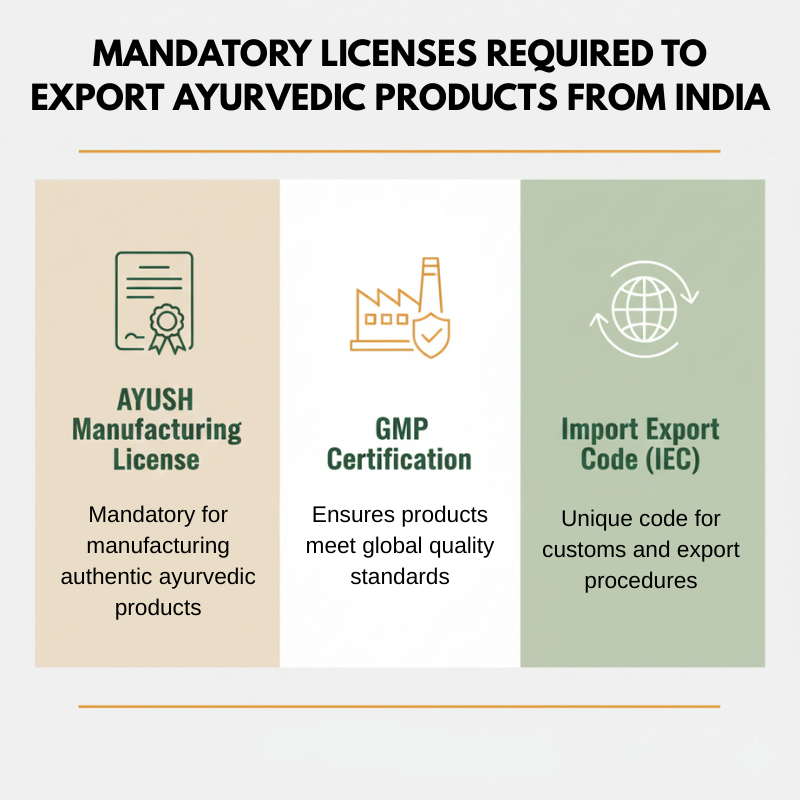
    Mandatory licenses required to export Ayurvedic products from India including AYUSH license, GMP certification, and IEC

    AYUSH Manufacturing License

    An AYUSH manufacturing license is mandatory if the product is classified as an ayurvedic medicine or carries therapeutic claims. It is issued by State AYUSH authorities and validates the legal manufacture of the product.

    GMP-Certification

    GMP-certified ayurvedic manufacturer status is a baseline requirement for most international buyers. GMP demonstrates that products are manufactured under controlled conditions with documented processes, hygiene standards, and quality checks.

    Import Export Code (IEC)

    Issued by the Directorate General of Foreign Trade, IEC is a non-negotiable requirement for any exporter. Without it, no legal export activity can take place.

    Need a GMP-certified Ayurvedic product manufacturer with export-ready documentation support?

    Explore Sage Herbals’ manufacturing & private label services tailored for exporters. 

    Complete List of Documents Required to Export Ayurvedic Products from India

    Manufacturing & Product Documents

    These establish the legitimacy and formulation of the product. They usually include AYUSH approval where applicable, detailed product composition, and stability data supporting shelf life.

    Quality & Compliance Documents

    Quality documents prove that the product meets defined standards. Common documents include the GMP certificate, Certificate of Analysis, and Material Safety Data Sheet.

    Export & Shipping Documents

    These support the physical movement of goods and include a commercial invoice, a packing list, and a certificate of origin.

    Managing multiple licenses, test reports, and country-specific approvals often leads to compliance gaps.
    This step-by-step documentation guide helps exporters track responsibilities, timelines, and authority-wise requirements in one structured framework.

    How Long Does the Documentation Process Take for Ayurvedic Export?

    The documentation timeline to export Ayurvedic products from India depends on product type, classification, and target market. There is no single fixed timeline because some approvals are one-time, while others are product-specific or country-specific.

    For Ayurvedic medicines, documentation can take longer due to AYUSH approvals, stability data preparation, and compliance checks. Herbal cosmetics and personal care products usually have a shorter documentation cycle but still require careful labeling and ingredient validation.

    Which Document Is Required First for Ayurvedic Export?

    The first document required to export Ayurvedic products from India is a correct product classification supported by manufacturing approval. Without precise classification, no other document holds value.

    For Ayurvedic medicines, AYUSH manufacturing approval is the starting point. For herbal cosmetics, ingredient validation and formulation documentation are the priorities. An Import Export Code is also mandatory at an early stage because no export activity can proceed without it.

    Starting documentation in the wrong order often leads to duplication, rejections, and increased compliance costs. A structured approach saves time and avoids regulatory errors.

    Labeling Requirements for Exporting Ayurvedic Products

    Labeling is one of the most underestimated risk areas in Ayurvedic exports. Many shipments fail due to incorrect or incomplete labels.

    Mandatory label elements usually include product name, ingredient declaration, manufacturer details, batch number, and expiry date. Claim restrictions apply strictly, especially to products entering regulated markets such as the USA or the EU.

    Indian domestic labels often differ significantly from international requirements. Using the same label without modification is a common cause of rejection.

    Country-Specific Export Compliance (USA, EU, Middle East)

    USA (FDA Considerations)

    In the United States, product classification depends on claims and intended use. FDA registration requirements vary accordingly.. Some categories require facility registration, while others focus on product compliance.

    EU Regulations

    The European Union follows a structured compliance framework. Cosmetic products require CPNP registration and safety assessment by a qualified professional. Compliance is usually product-specific, not company-wide.

    Middle East

    Middle Eastern markets often require local authority registration, longer approval timelines, and, in some cases, halal documentation. Regulatory expectations differ by country, so pre-checks are essential.

    Cost Range for Ayurvedic Export Documentation and Compliance

    The cost of complying with export requirements for Ayurvedic products from India varies by product category, documentation depth, and target market. There is no fixed cost structure because some expenses are one-time, while others are product-wise or market-wise.

    Costs generally include licensing, testing, stability studies, labeling updates, and country-specific registrations. Ayurvedic medicines usually involve higher compliance costs than herbal cosmetics due to stricter regulatory requirements.

    Planning compliance costs early helps exporters avoid budget overruns and rushed documentation that increases the risk of rejection.

    Private Label Ayurvedic Export from India

    Private-label Ayurvedic manufacturing changes compliance responsibility and distribution. The brand owner is responsible for market claims and positioning, while the manufacturer must support testing, documentation, and regulatory alignment.

    Manufacturer capability plays a critical role here. A weak manufacturer increases regulatory risk, regardless of brand strength.

    How Sage Herbal Supports Global Ayurvedic Export?

    Sage Herbal operates with a compliance-first manufacturing approach. The company has GMP, ISO, and FSSAI-certified facilities, supported by in-house R&D and testing laboratories.

    Export-ready documentation support, private label capability, and regulatory alignment form the operational backbone. The focus remains on accuracy, traceability, and long-term regulatory credibility rather than marketing claims.

    Connect with Sage Herbal to understand export documentation requirements, regulatory compliance, and manufacturing readiness for your target markets.

    Frequently Asked Questions

    1. Do we need an AYUSH license to export Ayurvedic products from India?

    Yes. If we classify the product as an Ayurvedic medicine, we must obtain an AYUSH license before we export Ayurvedic products from India.

    2. Is GMP mandatory for Ayurvedic export?

    For most serious export markets and buyers, GMP certification is expected.

    3. Can we export herbal cosmetic products from India?

    Yes. We can export herbal cosmetics under cosmetic regulations, provided we follow proper labeling and compliance rules.

    4. How long does Ayurvedic export registration take?

    The timeline varies. We see different approval times based on product category and the regulations of the destination country.

    Conclusion

    Exporting Ayurvedic Products from India offers strong global potential, but success depends on correct documentation, product classification, and regulatory compliance. From mandatory licenses and labeling to country-specific rules, every step plays a role in avoiding delays and shipment rejection.

    A compliance-first approach with a GMP-certified ayurvedic manufacturer helps manage export documentation, India requirements, and international herbal regulations with confidence. Proper planning reduces risk and supports long-term export growth.

    Download the Complete Export Ayurvedic Products from India Documentation Guide(PDF)

    This guide includes detailed workflows, authority-wise documentation responsibilities, labeling checklists, testing requirements, and country-specific compliance insights for serious exporters.

    Please subscribe to our social channels for updates related to Ayurvedic skincare, research-based herbs, and wellness tips.

    InstagramSage Herbals

    FacebookSage Herbals

    YouTubeSage Herbals

    LinkedInSage Herbals Pvt.Ltd.

  • Clinical Testing for Ayurvedic Skincare: Why It Matters and How It’s Done

    Clinical Testing for Ayurvedic Skincare: Why It Matters and How It’s Done

    Introduction

    Ayurvedic skincare is strongly connected with tradition and natural ingredients. However, expectations have changed over time. Today, people want more than tradition. They want to know if a product is safe, works the same every time, and suits real people’s skin in daily use.

    Today, this proof mostly comes from well-planned safety checks on people and skin studies carried out under clear testing rules.

    This change has made Clinical Testing for Ayurvedic Skincare more important than before. Brands, buyers, and even aware consumers now look beyond labels and claims. They look for clear proof that herbal products are safe for human skin.

    When brands test carefully and openly, they protect users, follow rules, and build lasting trust in a crowded market.

    This article explains what Clinical Testing for Ayurvedic Skincare means in real use, why it matters today, and how fair testing helps Ayurvedic brands build trust, meet rule expectations, and grow safely.

    Why Clinical Testing Matters in Ayurvedic Skincare Today?

    For a long time, “natural” was enough to earn trust. That is no longer true. Consumers, regulators, and global buyers now ask a more complicated question. Is the product proven to be safe and tested on real people under real usage conditions?

    This is where clinical testing of Ayurvedic skincare becomes important and plays a key role. It helps brands stop guessing and show responsibility through recorded safety checks. In today’s market, trust is not built on tradition alone. It comes from proof that products stay safe during real, everyday use.

    Industry research shows that the global Cosmetics and Personal Care Safety and Effectiveness Testing Market was valued at USD 5.3 billion in 2024 and is expected to reach USD 10.2 billion by 2033. This clearly shows the growing need for proper safety and performance testing in skincare and cosmetic products.

    Because of this, clinical testing becomes necessary for brands that want credibility, export readiness, and long-term consumer trust.

    What is clinical testing in ayurvedic skincare?

    Clinical testing in ayurvedic skincare is a clear and fair process where herbal skincare products are tested on real people with different skin types. The main goal is to check safety, skin comfort, and how the product performs under controlled conditions before it reaches the market.

    This testing helps brands understand how a product behaves on real skin, not just in theory or on paper.It focuses on skin compatibility and user safety, making sure the product is suitable for everyday use and does not cause unwanted skin reactions.

    What Clinical Testing Means in Ayurvedic Skincare in the Context of Clinical Validation?

    In the context of clinical validation, clinical testing in ayurvedic skincare means human-based evaluation carried out by following clear and defined testing rules. It is used to confirm the safety and skin compatibility of herbal formulations with proper proof. This is very different from unclear claims like “tested” or “dermatologically safe” that are made without supporting evidence.

    Clinical testing involves

    • Human safety and tolerance evaluation
    • Observation under controlled usage conditions
    • Documented results reviewed by qualified experts

    Herbal ingredients also require proper validation. Being natural does not remove the risk of skin irritation, allergy, or incompatibility, especially when multiple herbs are combined in one formulation.

    Dermatologists, Contract Research Organizations, and trained research and testing teams usually conduct clinical testing. When done correctly, it results in clinically tested herbal skincare products, safety-validated products, and research-backed formulations that can handle strict review and regulatory scrutiny.

    Lab Testing vs Clinical Testing in Ayurveda

    Understanding the Difference Clearly for This Testing Approach

    Many brands mix up lab testing with clinical testing, but they are not the same. The difference becomes very clear when seen from a clinical testing point of view.

    What lab testing covers

    • Raw material quality testing
    • Microbial safety checks
    • Stability and shelf-life analysis

    What clinical testing covers

    • Human skin compatibility
    • Irritation and sensitivity evaluation
    • Performance observation during actual use

    Lab testing checks the product itself. Clinical testing checks how the product behaves on human skin. Both are important, but one cannot replace the other. For exports and serious brand building, clinical testing of ayurvedic skincare plays a key role that lab testing alone cannot achieve.

    Step-by-Step Clinical Testing Process for Ayurvedic Skincare Products

    How Clinical Evaluation Works in Real Practice?

    Below is how clinical testing of ayurvedic skincare is usually done in an organised and rule-following way.

    Step 1: Pre-Clinical Safety and Formulation Assessment

    Herbal skincare formulation evaluation in laboratory during pre-clinical safety assessment

    Ingredient safety is checked, ayurvedic references are reviewed, and basic lab testing is done to make sure the formulation is safe before moving into clinical testing.

    Step 2: Dermatological Review and Protocol Design
    In this step, dermatologists are involved, testing goals are clearly defined, and ethical approvals are taken where required for the testing process.

    Step 3: Human Patch Testing and Skin Compatibility Studies
    The product is applied in a controlled way on volunteers. Skin is then monitored for irritation or sensitivity, and observations are recorded using standard tracking methods.

    Step 4: Usage-Based Clinical Evaluation
    Short-term use trials are carried out to observe how the skin responds during normal use, without making medical claims, during the evaluation process.

    Step 5: Data Analysis, Reporting, and Documentation
    Results are interpreted carefully, claim support language is defined, and compliance-ready documentation is prepared within the clinical framework.

    Each step is recorded, and conclusions are based on actual observations. This detailed process is what makes clinical testing trustworthy and reliable.

    What Tests Are Usually Included in Clinical Evaluation?

    Below are the common tests usually included in a standard clinical evaluation of skincare products.

    • Patch testing for skin irritation and sensitivity
      The product is applied in a controlled manner to check for redness, itching, or irritation, helping identify early skin reactions before regular use.
    • Short-term usage study under dermatologist supervision
      Volunteers use the product for a defined period while dermatologists monitor skin response to ensure it remains safe during normal, everyday application.
    • Skin comfort and tolerance observation
      Skin feel, comfort, and overall tolerance are observed to confirm that the formulation suits different skin types without causing discomfort.
    • Documentation of adverse reactions, if any
      Any negative skin response is carefully recorded and reviewed, ensuring transparency and proper safety documentation within the clinical evaluation process.

    Regulatory Requirements for Clinical Testing in Ayurvedic Skincare

    Compliance Requirements for Ayurvedic Skincare Testing

    This section is very important for brands that focus on rules, safety, and compliance while following this testing approach.

    India

    In India, CDSCO sets safety standards for ayurvedic skincare products, while AYUSH guidelines guide herbal formulation rules. Ayurvedic product regulations require proper safety proof, and clinical testing becomes important when products make performance-related claims during the clinical process.

    Global Export Markets

    USA

    In the USA, there is a strong focus on skin safety. Human safety testing is expected as part of responsible clinical evaluation before products enter the market.

    EU

    The EU places high importance on strict documentation and safety assessment. There is a strong focus on human skin compatibility data linked to Clinical Testing for Ayurvedic Skincare.

    Middle East

    Middle East markets are increasingly asking for clear safety proof supported by Clinical Testing for Ayurvedic Skincare.

    Overall, clinical testing of ayurvedic skincare helps reduce regulatory risk and allows brands to clearly separate rule compliance from marketing claims.

    Common Myths About Clinical Testing in Ayurvedic Products

    Clinical Testing for Ayurvedic Skincare Explained

    Myth 1: Natural products do not need clinical testing
    Natural ingredients can still cause skin reactions. Clinical testing helps protect both consumers and brands by checking safety properly.

    Myth 2: Clinical testing destroys Ayurvedic authenticity
    Clinical testing checks safety, not beliefs or philosophy. Ayurveda stays unchanged within the clinical testing process.

    Myth 3: Only synthetic products are clinically tested

    Herbal products are also expected to meet the same safety standards as other skincare products.

    Myth 4: Lab tests are enough
    Lab tests do not show how human skin reacts over time. Real skin observations matter more than assumptions.

    Why Clinical Testing Is Critical for Brands and Private Label Buyers?

    The Business Value of Clinical Testing for Ayurvedic Skincare

    Clinical testing helps build consumer trust and long-term brand credibility by showing responsible safety practices. It supports export readiness, reduces the chances of compliance rejection, and strengthens the proof behind product claims.

    It also lowers legal and brand image risk and makes product acceptance easier for retailers and distributors. For serious buyers, clinical testing of ayurvedic skincare shows responsibility and professionalism, not over-promotion, in a regulated market.

    How Sage Herbals Approaches Clinical Testing Ethically and Scientifically?

    Clinical Testing for Ayurvedic Skincare at Sage Herbals

    Since 1990, Sage Herbals has followed a research-driven philosophy rooted in both dermatology and holistic healthcare, aligned with this testing philosophy. The foundation is rooted in the legacy of its founder, a dermatologist committed to ethical research and education.

    The clinical testing process at Sage Herbals is supported by in-house R&D and laboratory facilities, dermatology-linked safety protocols, and a GMP-certified manufacturing setup. The focus remains on proper evaluation rather than exaggerated claims, backed by years of experience, scientific expertise, and transparent practices within the clinical framework.

    Clinical Testing and Consumer Safety

    What It Actually Protects Through Clinical Testing for Ayurvedic Skincare?

    Clinical evaluation helps protect users from skin irritation, supports sensitive-skin needs, and builds confidence in long-term product use. It allows brands to identify possible skin reactions early and reduce risk before products reach customers. This makes everyday use safer and more reliable for different skin types.

    Manufacturers also have a responsibility to make sure products are properly checked for safety and designed to support skin compatibility, without making medical promises. Responsible clinical testing helps brands act ethically while meeting consumer and regulatory expectations.

    Frequently Asked Questions

    1. Are Ayurvedic skincare products clinically tested today?

    Yes, many responsible brands follow Clinical Testing for Ayurvedic Skincare to check safety on real human skin. This helps confirm skin comfort and reduces risk before products are launched in the market.

    2. Is clinical testing mandatory for Ayurvedic skincare products?

    Clinical testing is not always mandatory. However, it becomes important when brands make safety or performance-related claims. Export markets and informed buyers often expect Clinical Testing for Ayurvedic Skincare.

    3. How long does clinical testing for Ayurvedic skincare usually take?

    The time required depends on the testing method and product type. In most cases, Clinical Testing for Ayurvedic Skincare takes a few weeks under controlled and fair testing conditions.

    4. Who conducts clinical testing for Ayurvedic skincare products?

    Qualified dermatologists and approved research organizations conduct Clinical Testing for Ayurvedic Skincare. They follow clear testing rules and carefully record all results.

    Conclusion

    Ayurveda and science are not opposites. They work best when used together. When traditional knowledge is supported by proper evaluation, it builds confidence among consumers, regulators, and global partners.

    Clinical testing of Ayurvedic cosmetics reflects responsibility, safety, and long-term trust. It helps strengthen brands, protect consumers, and support global acceptance through Clinical Testing for Ayurvedic Skincare. It also shows that a brand takes compliance, transparency, and ethical manufacturing seriously.

    Sage Herbals stands out as a compliant and experienced manufacturing partner that understands this balance and applies it consistently across every stage of product development.

    Learn how Sage Herbals develops clinically evaluated ayurvedic skincare products through ethical, transparent, and science-backed processes.

    Please subscribe to our social channels for updates related to Ayurvedic skincare, research-based herbs, and wellness tips.

    InstagramSage Herbals

    FacebookSage Herbals

    YouTubeSage Herbals

    LinkedInSage Herbals Pvt.Ltd.

  • Ayurvedic Ingredients for Skin – Top 10 Science-Backed Herbs

    Ayurvedic Ingredients for Skin – Top 10 Science-Backed Herbs

    Introduction

    According to a 2023 clinical review by Karger Publishers, topical curcumin significantly improves skin health because of its strong antioxidant, anti-inflammatory, and antimicrobial effects. Source: Karger Publishers (2023)

    This scientific evidence forms the base for many of the most effective ayurvedic ingredients for skin used today.

    Ayurveda blends ancient herbal wisdom with modern dermatology to create science-backed Ayurvedic skincare solutions, giving us natural yet clinically supported ways to brighten the skin, calm irritation, and strengthen the skin barrier.

    For over 30 years, Sage Herbal has followed this same philosophy by combining trusted Ayurvedic herbs with research-driven formulation.

    In this guide, you will learn how these top Ayurvedic ingredients work, why science supports them, and how they naturally enhance skin glow and overall skin health.

    What Makes Ayurvedic Ingredients for Skin Effective?

    Ayurvedic herbs are rich in antioxidants, anti-inflammatory plant actives, and natural nutrients that support long-term skin health. These herbs contain natural actives that help strengthen the skin barrier, protect the skin from everyday damage, and prevent dullness, acne, and pigmentation.

    This powerful synergy of Ayurveda and dermatology-backed research makes these Ayurvedic ingredients for skin ideal for everyday skincare. Sage Herbal’s R&D team follows this dual approach by validating traditional herbs through modern testing methods, ensuring both safety and effectiveness.

    What Ayurveda Says About Skin Types?

    Ayurveda explains skin health through the balance of Vata, Pitta, and Kapha.

    Vata Skin

    • Dry, thin, and easily dehydrated.
    • Imbalance leads to roughness, fine lines, and dullness.
    • Calming herbs: Aloe vera, Ashwagandha, Licorice.

    Pitta Skin

    • Sensitive, combination type, may show redness.
    • Imbalance causes inflammation, pigmentation, and acne.
    • Cooling herbs: Manjistha, Sandalwood, Neem.

    Kapha Skin

    • Oily, thick, and congestion-prone.
    • Imbalance causes acne, uneven tone, and whiteheads.
    • Clarifying herbs: Turmeric, Neem, Gotu Kola.

    When doshas become imbalanced, the skin loses radiance and becomes prone to dullness, breakouts, and pigmentation. Identifying your dosha helps you choose the right ayurvedic ingredients for skin, ensuring targeted and effective care.

    Signs Your Skin Needs Ayurvedic Ingredients

    You may benefit from ayurvedic ingredients for skin and ayurvedic herbs for glowing skin if you notice:

    • Dullness or loss of glow
    • Uneven pigmentation
    • Redness, burning, or sensitivity
    • Frequent acne or stress-related breakouts
    • Fine lines or loss of firmness
    • Irritation after chemical-heavy skincare

    Herbs gently heal, nourish, and correct imbalances without harsh effects, making them a safer option when your skin feels overwhelmed or stressed.

    Top 10 Ayurvedic Ingredients for Skin and Glowing Skin Benefits

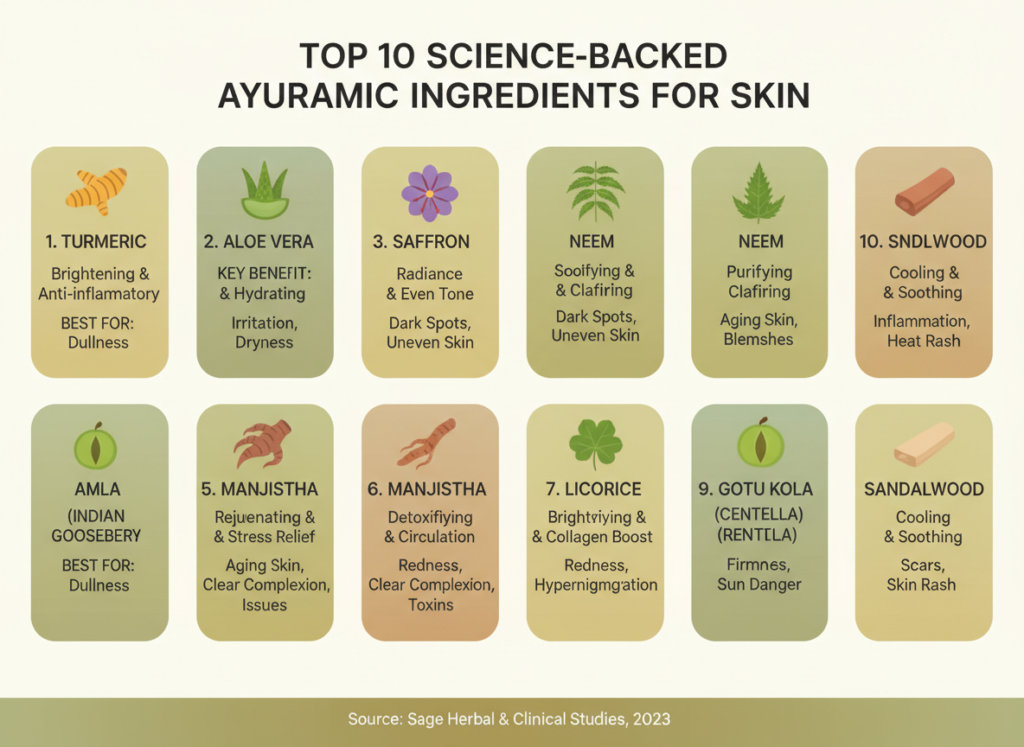
    Infographic showing top 10 science-backed Ayurvedic ingredients for skin, including turmeric, aloe vera, saffron, neem, manjistha, amla, licorice, gotu kola, and sandalwood with their key skin benefits.

    Here are the top ayurvedic ingredients for skin and other herbal skincare ingredients, their benefits, and usage tips supported by traditional wisdom and modern research.

    1. Turmeric (Haridra) – Anti-inflammatory + Brightening

    Turmeric is one of the most powerful ayurvedic ingredients for skin and one of the most trusted ayurvedic herbs for glowing skin because of curcumin(a plant compound in turmeric), which fights inflammation and reduces pigmentation.

    Science says: Curcumin shows antioxidant, anti-inflammatory, and antimicrobial benefits (Karger, 2023).

    Best for: All skin types, dullness, pigmentation
    How to use: Face masks, serums, gentle cleansers
    Extra guidance: Use 1–2x weekly or in low-strength daily serums and always patch tests.

    You can also explore our Best Ayurvedic skin care products – Sage Herbals for deeper nourishment and glow.

    2. Aloe Vera – Hydration + Healing

    Aloe vera deeply hydrates and supports barrier repair. Its cooling nature makes it ideal for sensitive and acne-prone skin.

    Benefits:

    • Reduces redness
    • Speeds healing
    • Soothes irritation
      Use in: Gels, moisturizers, calming serums
      Extra guidance: Safe for daily use, especially after sun exposure or irritation.

    3. Saffron (Kesar) – Radiance-Boosting Herb

    Saffron has been traditionally used for improving complexion and glow.

    Science-backed benefits: Brightening, tone correction, antioxidant support
    Ideal for: Dullness, uneven tone
    Use: Infused oils, night serums
    Extra guidance: Best used at night for gradual radiance improvement.

    4. Neem – Clarifying + Acne Control

    Neem contains nimbidin, a well-studied antibacterial compound.

    Benefits:

    • Controls acne-causing bacteria
    • Reduces inflammation
    • Balances oil production

      Best for: Oily, acne-prone skin
      Use: Cleansers, spot gels, purifying masks
      Extra guidance: Use 2–3× weekly; avoid over-dryness by pairing with a hydrating gel.

    5. Ashwagandha – Powerful Anti-Aging Herb

    Ashwagandha is an adaptogen that reduces oxidative stress, a major cause of premature aging.

    Benefits:

    • Boosts firmness
    • Reduces fine lines
    • Supports skin recovery
      Use: Serums, creams, facial oils
      Extra guidance: Ideal for nighttime routines for deeper repair.

    6. Manjistha – Pigmentation & Detox Herb

    Manjistha is a key herb used in many skincare formulas because it helps clear internal heat and supports the natural detox process, which can reduce pigmentation.

    Why it works: Helps even skin tone and reduce dark spots
    Best for: Pigmentation-prone skin
    Use: Brightening creams, serums,and  herbal masks
    Extra guidance: Works best when used consistently 3–4× weekly.

    7. Licorice (Yashtimadhu) – Natural Brightener

    Licorice contains glabridin(a licorice compound that helps reduce pigment), a compound that helps reduce melanin activity.

    Benefits:

    • Brightens
    • Reduces tanning
    • Calms sensitivity
      Use: Serums, soothing creams
      Extra guidance: Great for sensitive skin; can be used daily in low concentration.

    8. Amla – Vitamin C Powerhouse

    Amla is a natural source of Vitamin C, which boosts collagen and radiance.

    Benefits:

    • Brightens
    • Improves firmness
    • Strengthens the skin barrier
      Use: Serums, rejuvenating masks
      Extra guidance: Best paired with sunscreen in the morning routine.

    9. Gotu Kola (Centella) – Skin Barrier Support

    Gotu Kola supports collagen development and helps fade scars.

    Benefits:

    • Reduces fine lines
    • Strengthens skin barrier
    • Smoothens texture
      Use: Serums, creams, barrier repair formulations
      Extra guidance: Ideal for daily use, especially for sensitive or damaged skin barriers.

    10. Sandalwood – Cooling + Glow Enhancing

    Sandalwood is revered for its calming and complexion-enhancing effects.

    Benefits:

    • Reduces tanning
    • Controls inflammation
    • Improves natural glow
      Use: Calming packs, cleansers, serums
      Extra guidance: Always patch test if you have sensitive skin.

    How Ayurvedic Ingredients for Skin Work Together for Better Results?

    When combined thoughtfully, these ayurvedic ingredients for skin offer:

    • Deep antioxidant protection
    • Brightening and pigmentation control
    • Acne reduction and balanced oil levels
    • Collagen support and firming
    • A stronger, healthier skin barrier
    • Reduced sensitivity and inflammation

    This is why these herbs work well together in Ayurvedic skincare, which focuses on blend-based formulations rather than single herbs. The combined actives deliver broader and more effective skin benefits.

    Ayurvedic Ingredients for Skin: Suitability by Skin Type

    Here is a quick skin-type guide to help you choose the most suitable Ayurvedic ingredients for skin based on your specific concerns.

    Skin TypeBest Ayurvedic IngredientsWhy They Work
    Dry SkinAloe vera, Ashwagandha, LicoriceHydration, barrier repair, calming
    Oily SkinTurmeric, Neem, Gotu KolaClarifies pores, controls excess oil
    Acne-Prone SkinNeem, Turmeric, Aloe veraAntibacterial, reduces inflammation
    Pigmentation-Prone SkinManjistha, Licorice, SaffronBrightening, melanin control
    Aging SkinAshwagandha, Amla, Gotu KolaAnti-oxidant protection, firming
    Sensitive SkinAloe vera, Sandalwood, LicoriceCooling, soothing, barrier support

    This simple guide helps you identify the right ayurvedic ingredients for skin based on your unique skin needs.

    How to Use Ayurvedic Ingredients for Skin Safely and Effectively?

    Ayurvedic herbs are powerful yet gentle, but correct usage ensures maximum benefit from ayurvedic ingredients for skin.

    1. Always Patch Test
      Even natural herbs can trigger sensitivity. Apply a small amount on the inner arm and wait 24 hours.
    2. Start With 2–3 Ingredients
      Avoid mixing too many herbs at once. Ayurveda works best with balanced blends.
    3. Use Consistently
      Skin takes around a month to renew, and herbal actives work best when used regularly over time.
    4. Safe Combinations
      Turmeric + Aloe vera → Brightening + calming
      Manjistha + Licorice → Pigmentation control
      Gotu Kola + Amla → Anti-aging + collagen support
    5. Avoid These Combinations
      Strong exfoliants with turmeric
      Neem with retinoids (can cause dryness)
      Citrus oils on sensitive skin

    Following these guidelines ensures Ayurvedic herbs support your skin effectively without irritation.

    Common Myths About Ayurvedic Ingredients for Skin

    Myth 1: Ayurveda is slow
    Fact: Herbal activities start working from day one, especially antioxidant and anti-inflammatory compounds. Visible improvements appear in 2–4 weeks.

    Myth 2: Natural products don’t need patch testing
    Fact: Even natural extracts can irritate sensitive skin. Patch testing is essential.

    Myth 3: Ayurveda has no scientific support
    Fact: Many clinical studies, including the 2023 Karger review on curcumin, confirm the skin benefits of Ayurvedic herbs.

    Myth 4: One herb suits everyone
    Fact: Ayurveda is personalized. Skin type, season, and dosha determine which herbs work best.

    Myth 5: More ingredients give better results
    Fact: Balanced formulations work better than overloaded recipes.

    Ayurvedic skincare works best when tradition, science, and the right method come together in your routine.

    Science-Backed Benefits of Ayurvedic Ingredients for Skin

    When used consistently, the top ayurvedic ingredients for skin and science-backed Ayurvedic skincare routines offer benefits supported by both Ayurveda and dermatology:

    Brighter and more even skin tone:
    Saffron, Licorice, and Manjistha help reduce melanin activity.

    Reduced pigmentation and dark spots:
    Clinically supported herbs like Manjistha and curcumin help reduce dark spots and uneven pigmentation.

    Calmer acne and inflammation:
    Neem, turmeric, and aloe vera fight bacteria and soothe irritation.

    Stronger and healthier skin barrier:
    Gotu Kola and aloe vera improve moisture retention and resilience.

    Youthful firmness and reduced fine lines:
    Amla and Ashwagandha support collagen production.

    Better hydration and long-term glow:
    Herbal ingredients nourish the skin deeply without overwhelming it.

    Ayurvedic skincare works because it addresses both internal causes and external symptoms naturally.

    Why Choose Sage Herbal for Ayurvedic Ingredients for Skin Care?

    Sage Herbal stands out because it blends classical Ayurvedic wisdom with clinical research, ensuring safe, effective, and ethically crafted products.

    1. Over 30 Years of Dermatology-Backed Expertise
    Founded by the renowned Dr. P. N. Behl, Sage Herbal combines deep Ayurvedic knowledge with medical understanding.

    2. Clinically Tested Herbal Formulations
    Every formulation undergoes research, stability checks, and safety testing.

    3. GMP, ISO, and FSSAI-Certified Manufacturing
    These certifications ensure purity, quality, and global compliance.

    4. Strong R&D Foundation
    An in-house research team validates herbs using scientific methods.

    5. Ingredient Transparency
    Only pure, authentic herbs are sourced responsibly.

    This credibility makes Sage Herbal a trusted choice for anyone seeking natural, science-backed skincare solutions crafted with integrity.

    Frequently Asked Questions

    1. Which Ayurvedic ingredient is best for glowing skin?

    Turmeric, saffron, and manjistha are considered the most effective glow-enhancing herbs.

    2. Are Ayurvedic ingredients safe for all skin types?

    Yes, they are generally safe, but patch testing is important, especially for sensitive skin.

    3. What is the most powerful Ayurvedic herb for anti-aging?

    Amla and Ashwagandha are top choices because they support collagen and help reduce fine lines.

    4. How do I use Ayurvedic ingredients for skin at home?

    You can apply them as serums, face masks, cleansers, or infused oils based on your skin type.

    Conclusion

    Ayurveda and science-backed Ayurvedic skincare together offer powerful, time-tested solutions for skin health, now supported by modern clinical research. The best ayurvedic ingredients for skin brighten, calm, protect, and rejuvenate when used correctly and consistently.

    With Sage Herbal’s science-backed formulations, you get the purity of traditional herbs combined with the trust of dermatology. Each product reflects Dr. P. N. Behl’s legacy of bringing together Ayurvedic wisdom and modern research.

    To simplify your routine, explore Sage Herbals’ clinically tested, Ayurveda-based Skin Care formulations that support long-term skin health and natural radiance.

    Please subscribe to our social channels for updates related to Ayurvedic skincare, research-based herbs, and wellness tips.

    InstagramSage Herbals

    FacebookSage Herbals 

    YouTube: Sage Herbals

    LinkedIn: Sage Herbals Pvt.Ltd.
  • Top 5 Benefits of Employing an Ayurvedic Contract Manufacturer

    Top 5 Benefits of Employing an Ayurvedic Contract Manufacturer

    Employing an Ayurvedic contract manufacturer offers numerous advantages for businesses looking to enter or expand in the herbal products market. As the demand for Ayurvedic solutions continues to rise, partnering with a specialized manufacturer allows brands to focus on marketing and distribution while benefiting from the expertise and resources of established manufacturers. Here are the top five benefits of employing an Ayurvedic contract manufacturer.

    1. Cost Effectiveness

    One of the most significant advantages of using an Ayurvedic contract manufacturer is cost savings. Establishing an in-house manufacturing facility requires substantial investment in equipment, raw materials, staffing, and compliance with regulatory standards. By outsourcing production, businesses can significantly reduce overhead costs associated with:

    • Infrastructure: Building and maintaining manufacturing facilities can be prohibitively expensive.
    • Labor Costs: Hiring skilled personnel, including technicians and quality control experts, adds to operational expenses.
    • Regulatory Compliance: Ensuring adherence to industry regulations involves additional costs related to licenses, inspections, and certifications.

    Contract manufacturers already have the necessary infrastructure and expertise in place, allowing brands to benefit from economies of scale. This means lower production costs can be passed on to consumers or reinvested into the business for growth initiatives.

    Example:

    For instance, a startup looking to launch a line of herbal supplements would face high initial costs if it attempted to set up its own manufacturing facility. By partnering with a contract manufacturer, the startup can avoid these expenses and focus its resources on marketing and product development.

    2. Access to Expertise

    Partnering with an Ayurvedic contract manufacturer provides access to specialized knowledge and experience that may not be available in-house. These manufacturers typically employ teams of experts, including herbalists, chemists, and quality control professionals who understand the intricacies of Ayurvedic formulations and production processes.

    • Formulation Development: Contract manufacturers can assist in developing unique formulations tailored to market demands, leveraging their knowledge of effective herbal ingredients.
    • Quality Assurance: Experienced manufacturers implement rigorous quality control measures throughout the production process, ensuring that products meet safety and efficacy standards.

    This expertise helps brands maintain high product quality while also navigating the complexities of compliance with local and international regulations.

    Example:

    A company aiming to produce a new herbal skincare line can benefit from a contract manufacturer’s expertise in sourcing high-quality ingredients and ensuring that formulations are both effective and compliant with cosmetic regulations.

    3. Faster Time to Market

    In today’s competitive market, speed is essential for success. By employing a contract manufacturer, businesses can significantly reduce the time it takes to bring products to market. This is achieved through:

    • Streamlined Production Processes: Established manufacturers have optimized their operations for efficiency, allowing them to produce large quantities of products quickly.
    • Reduced Development Time: With access to experienced teams and existing formulations, brands can expedite product development cycles.

    Faster time-to-market enables companies to capitalize on emerging trends and consumer demands more effectively than if they were managing production internally.

    Example:

    During a surge in demand for immunity-boosting supplements due to health concerns, a brand that collaborates with a contract manufacturer can quickly launch its product line without the delays associated with setting up its own production facilities.

    4. Scalability

    Scalability is another critical benefit of partnering with an Ayurvedic contract manufacturer. As a brand grows and demand for its products increases, a contract manufacturer can easily adjust production levels without requiring significant investment in new facilities or equipment.

    • Flexibility in Production Volume: Contract manufacturers can accommodate varying order sizes, whether a brand needs small batches for testing or large-scale production for widespread distribution.
    • Adaptability to Market Changes: If market trends shift or new opportunities arise, contract manufacturers can quickly pivot their production capabilities to meet changing demands.

    This flexibility allows brands to respond swiftly to market conditions while minimizing financial risk associated with overproduction or underutilization of resources.

    Example:

    A brand that experiences sudden popularity due to viral marketing may need to ramp up production quickly. A contract manufacturer can adjust its output accordingly without the brand having to invest in additional manufacturing capacity.

    5. Focus on Core Competencies

    By outsourcing manufacturing responsibilities, brands can concentrate on their core competencies such as marketing, branding, and customer engagement. This focus allows companies to:

    • Enhance Brand Identity: With more time dedicated to marketing strategies and brand development, businesses can strengthen their presence in the market.
    • Improve Customer Relationships: By focusing on customer service and engagement rather than manufacturing logistics, brands can build stronger relationships with their customers.

    Outsourcing manufacturing also frees up valuable resources that can be redirected towards innovation and expanding product lines.

    Example:

    A company specializing in Ayurvedic wellness products can dedicate more time and resources to developing marketing campaigns that resonate with consumers instead of managing complex manufacturing processes.

    Conclusion

    Employing an Ayurvedic contract manufacturer offers significant benefits that can enhance a brand’s efficiency and competitiveness in the growing herbal products market. From cost savings and access to specialized expertise to faster time-to-market and scalability, these advantages enable businesses to thrive without the heavy burden of managing production facilities.

    As more consumers seek natural and holistic health solutions, partnering with a reputable Ayurvedic contract manufacturer becomes a strategic move for brands looking to capitalize on this trend while maintaining high standards of quality and efficacy in their products. By focusing on core competencies such as marketing and customer engagement, businesses can position themselves for long-term success in the dynamic landscape of Ayurvedic products.

    In summary, choosing an Ayurvedic contract manufacturer not only streamlines operations but also empowers brands to innovate and adapt swiftly in an increasingly competitive marketplace. This partnership approach ultimately leads to better product offerings that meet consumer needs while fostering growth opportunities within the thriving Ayurvedic industry.

    References:

  • Outsourcing in Healthcare: How to Choose the Best Contract Manufacturer for Your Brand

    Outsourcing in Healthcare: How to Choose the Best Contract Manufacturer for Your Brand

    Your healthcare brand is on the brink of something extraordinary. You’ve envisioned products that can change lives, and you’re ready to scale up and reach more people than ever before. But here’s the catch—how do you ensure your products are crafted with the same care, quality, and innovation that your brand stands for? The answer lies in choosing the right contract manufacturer. This decision is more than a business transaction; it’s the foundation for your brand’s reputation, growth, and long-term success. Let’s explore, in detail, what you should look for, drawing inspiration from the industry-leading practices of Sage Herbals.

    1. Quality Control: The Bedrock of Trust

    • Certifications: GMP (Good Manufacturing Practices), ISO, and other relevant accreditations.
    • Batch Testing: Regular, transparent laboratory testing for purity, potency, and safety.
    • Traceability: The ability to track every ingredient back to its source.
    • Documentation: Detailed records for every batch, ensuring accountability and easy audits.

    Sage Herbals, for example, is known for its multi-layered quality checks and commitment to delivering safe, effective products every time.

    2. Regulatory Mastery: Navigating the Maze

    Healthcare regulations are complex and ever-changing. Whether you’re selling in India, the US, or Europe, your manufacturer must be a regulatory expert. Here’s what matters:

    • Global Compliance: Experience with FDA, AYUSH, EU, and other regulatory bodies.
    • Labeling & Claims: Guidance on compliant product labels and marketing claims.
    • Documentation Support: Assistance with product registrations, certifications, and audits.
    • Staying Updated: Proactive adaptation to new rules and regulations.

    A partner like Sage Herbals offers regulatory guidance, making your path to market smoother and safer.

    3. Supply Chain Strength: Never Out of Stock

    A strong supply chain means your products are always available, even in turbulent times. The best manufacturers:

    • Diversify Suppliers: Multiple sources for key ingredients to avoid disruptions.
    • Inventory Management: Advanced systems to predict demand and prevent shortages.
    • Quality Sourcing: Ethical, sustainable sourcing of raw materials, especially for herbal products.
    • Crisis Preparedness: Contingency plans for supply chain interruptions.

    Sage Herbals’ extensive sourcing network ensures consistent availability and quality of herbal ingredients.

    4. Customization and Innovation: Stand Out from the Crowd

    In a crowded market, unique products win. Your manufacturer should offer:

    • In-House R&D: A dedicated team to develop new formulations or improve existing ones.
    • Flexibility: Willingness to customize products, dosages, and packaging to your specifications.
    • Sampling: Ability to create prototypes and samples for market testing.
    • Packaging Solutions: Innovative, sustainable, and brand-aligned packaging options.

    Sage Herbals excels at turning your ideas into reality, supporting you from concept to finished product.

    5. Transparent Contracts: No Surprises, Only Solutions

    A clear, comprehensive contract protects your interests. Insist on:

    • Defined Timelines: Production schedules, delivery dates, and penalties for delays.
    • IP Protection: Clauses ensuring you own your formulations and branding.
    • Quality Guarantees: What happens if a batch doesn’t meet agreed standards?
    • Dispute Resolution: Clear steps for handling disagreements.

    Sage Herbals is known for its transparent, client-friendly contracts that foster trust and clarity.

    6. Communication: The Secret Ingredient

    Great partnerships are built on communication. Your manufacturer should:

    • Provide Regular Updates: Progress reports and open channels for questions.
    • Assign a Dedicated Contact: Someone who knows your project inside and out.
    • Be Proactive: Flagging potential issues early and offering solutions.
    • Encourage Collaboration: Welcoming your input and feedback at every stage.

    Sage Herbals values open, ongoing communication, ensuring you’re never left in the dark.

    7. Scalability: Grow Without Limits

    Your brand’s needs will change—sometimes overnight. The right manufacturer can:

    • Handle Small and Large Batches: From pilot runs to mass production.
    • Adapt Quickly: Ramp up or scale down production as needed.
    • Support New Launches: Fast turnaround for new products or seasonal demand.
    • Maintain Consistency: Deliver the same quality, no matter the order size.

    Sage Herbals’ flexible infrastructure means your growth never hits a bottleneck.

    8. Technology: The Modern Edge

    Modern manufacturing is about more than just machines. Look for:

    • Automation: Reduces errors, increases efficiency, and ensures consistency.
    • Digital Tracking: Real-time monitoring of production and supply chain.
    • Advanced Testing: State-of-the-art labs for quality and safety checks.
    • Sustainability: Technology that supports eco-friendly practices.

    Sage Herbals leverages technology to deliver reliable, innovative products at scale.

    9. Cost-Effectiveness: Value Beyond Price

    Outsourcing should save you money, but not at the expense of quality. Consider:

    • Transparent Pricing: No hidden fees or surprise charges.
    • Bulk Discounts: Savings for larger orders.
    • Efficiency: Streamlined processes that cut costs without cutting corners.
    • Total Value: Consider service, support, and quality—not just price per unit.

    Sage Herbals offers competitive pricing, ensuring you get premium value for your investment.

    10. Reputation: Trust Built Over Time

    Would you trust your brand with just anyone? Look for:

    • Industry Experience: Years of successful partnerships and product launches.
    • Client Testimonials: Positive feedback from other brands.
    • Awards & Recognition: Industry accolades and certifications.
    • Long-Term Relationships: Evidence of lasting client partnerships.

    Sage Herbals’ reputation for excellence and reliability makes them a preferred choice for healthcare brands worldwide.

    Your Brand’s Future Starts with the Right Partner

    Choosing a contract manufacturer isn’t just a business decision—it’s a leap of faith in your brand’s future. The right partner will not only manufacture your products but will also protect your reputation, fuel your growth, and help you innovate in a competitive market. Sage Herbals embodies all the qualities of an exceptional manufacturing partner: unwavering quality, regulatory expertise, supply chain resilience, and a collaborative spirit.

    So, as you take your brand to the next level, remember: Your product is your promise. Make it with a partner who shares your passion for excellence, and watch your vision flourish in the hands of experts.

  • Understanding The Role Of Pharma Product Manufacturers In The Healthcare Industry

    Understanding The Role Of Pharma Product Manufacturers In The Healthcare Industry

    Pause for a moment and think about your daily routine. The gentle facewash that wakes you up, the soothing lotion that calms your skin, the herbal oil that nourishes your hair—these essentials are more than just products; they are the result of innovation, tradition, and a relentless pursuit of well-being. But who crafts these solutions? Enter the world of pharmaceutical product manufacturers—the invisible architects of health. Among them, Sage Herbals stands tall, blending ancient Ayurvedic wisdom with modern science to deliver wellness that is as effective as it is natural. Let’s dive deeper into their world and discover how they are quietly transforming healthcare, one product at a time.

    The Unsung Heroes: What Do Pharma Product Manufacturers Really Do?

    Pharma product manufacturers are the backbone of the healthcare industry, yet their contributions often go unnoticed. Their work is multifaceted and crucial to our collective well-being.

    1. Innovators at Heart

    Pharma manufacturers are the driving force behind new discoveries in medicine and wellness. Their R&D teams investigate both time-honored remedies and cutting-edge scientific advances, searching for new ways to enhance health. For example, Sage Herbals draws from Ayurveda—a 5,000-year-old system of natural healing—while also using modern research to validate and refine their formulations. This dual approach ensures that each product is not only rooted in tradition but also meets today’s rigorous standards for efficacy.

    2. Guardians of Quality

    Quality is the cornerstone of trust in healthcare. Manufacturers like Sage Herbals implement strict quality control protocols at every stage of production. This includes sourcing raw materials from trusted suppliers, conducting laboratory tests for purity and potency, and adhering to Good Manufacturing Practices (GMP). The result? Products that are safe, consistent, and reliable—giving you peace of mind with every use.

    3. Champions of Access

    Pharma manufacturers play a pivotal role in making healthcare accessible. By producing a wide range of products—from daily personal care to specialized treatments—they cater to diverse needs and demographics. Sage Herbals, for instance, offers affordable, high-quality herbal solutions that reach urban and rural communities alike, ensuring that wellness is not a privilege but a right for all.

    Spotlight On Sage Herbals: Nature’s Own Alchemist

    The Sage Herbals Story

    Founded in 1990, Sage Herbals has become a leader in herbal and Ayurvedic product manufacturing. Their mission is to guide the world toward a healthier lifestyle by making herbal wellness accessible, effective, and enjoyable. With decades of expertise, they have built a reputation for trust, quality, and innovation.

    Key Offerings from Sage Herbals

    Skin Care: Sage Herbals’ facewashes, creams, and lotions are formulated to cleanse, hydrate, and rejuvenate, using botanical extracts like neem, aloe vera, and turmeric. These products are gentle enough for sensitive skin yet powerful enough to deliver visible results.

    Hair Care: Their oils and shampoos are enriched with Ayurvedic herbs such as amla, bhringraj, and hibiscus, promoting strong, lustrous hair while addressing common concerns like dandruff and hair fall.

    Personal Care: From soaps to gels, Sage Herbals crafts daily essentials that support holistic wellness. Each product is designed to nourish the body and uplift the senses.

    Specialty Products: Addressing specific health needs, Sage Herbals offers immunity boosters, pain relief balms, and more—each blending traditional knowledge with scientific validation.

    Checkout our Store: Sage Herbal Products

    Why Sage Herbals Stands Out

    Nature Meets Science: Every formula is a harmonious blend of ancient wisdom and contemporary research.

    Comprehensive Wellness: Their diverse product range means you can find a Sage Herbals solution for every aspect of your health and beauty routine.

    Inclusive and Gentle: Products are suitable for all ages and skin types, making them a family favorite.

    Constant Innovation: Sage Herbals stays ahead by monitoring global trends and continuously refining their offerings.

    The Sage Herbals Difference: A Closer Look

    Eco-Friendly and Sustainable

    Sage Herbals is deeply committed to environmental stewardship. They use sustainably sourced botanicals, minimize waste in production, and avoid harsh chemicals, ensuring that their products are as kind to the planet as they are to your body. Their packaging is designed to be eco-friendly, reflecting their holistic approach to wellness.

    Transparency and Trust

    Sage Herbals believes that informed consumers make healthier choices. That’s why they provide clear, honest labeling and educational resources about their ingredients and processes. This transparency builds trust and empowers you to take charge of your health.

    Global Reach, Local Roots

    While Sage Herbals has a global presence, they remain grounded in the rich traditions of Indian Ayurveda. Their products celebrate the diversity and depth of herbal medicine, bringing the best of India’s natural heritage to the world stage.

    The Broader Impact: Pharma Manufacturers and Public Health

    Pharma manufacturers like Sage Herbals are not just business entities—they are public health partners.

    Disease Prevention & Management

    By offering products that support immunity, skin health, and overall well-being, they help prevent illness and reduce the burden on healthcare systems. Herbal solutions can address common ailments naturally, often with fewer side effects.

    Sustainable Practices

    The focus on natural, plant-based ingredients aligns with global efforts to promote sustainability and reduce environmental impact. Sage Herbals’ commitment to green practices sets a benchmark for responsible manufacturing.

    Collaboration & Accessibility

    Through partnerships with healthcare providers, retailers, and community organizations, Sage Herbals ensures that high-quality herbal products are available to people from all walks of life. Their outreach and education initiatives further amplify their positive impact on public health.

    Embrace a New Era of Wellness

    The journey to good health is a partnership—between you, nature, and the innovators who bring nature’s gifts to your doorstep. Private Label Herbal company ike Sage Herbals are redefining what it means to care for yourself and your loved ones. By fusing tradition with technology, quality with accessibility, and sustainability with science, they are building a future where wellness is within everyone’s reach.

    So, are you ready to unlock the power of herbal wellness? Discover the Sage Herbals difference—where every product is a promise of health, harmony, and happiness. Your path to holistic well-being starts here!

    Share your favorite herbal remedy below or tell us which Sage Herbals product you can’t live without!

  • How to Find the Right Partner for Supplement Capsules 3rd party manufacturing in India?

    How to Find the Right Partner for Supplement Capsules 3rd party manufacturing in India?

    Finding the Right Partner for Supplement Capsules third-party manufacturing in India is a crucial step for entrepreneurs looking to enter the nutraceutical market. With the increasing demand for dietary supplements, selecting a reliable manufacturer can significantly impact your brand’s success. This blog will guide you through the essential steps and considerations for identifying the ideal manufacturing partner.

    What is Supplement Capsules?

    Supplement capsules are oral dietary products that contain essential nutrients like vitamins, minerals, herbs, or other beneficial substances. Encased in a dissolvable shell—usually made of gelatin or a plant-based alternative—these capsules are easy to swallow and help deliver nutrients efficiently into the body. They support overall health, boost immunity, improve energy, and target specific health concerns such as joint pain, skin health, or digestion. Unlike tablets or powders, capsules often contain fewer additives and are absorbed quickly. Whether for daily wellness or targeted needs, supplement capsules offer a convenient and effective way to enhance your nutritional intake.

    If you’re looking for best Supplement Capsules then Sage Herbal provides one of the Best Herbal Capsules in India.

    Who are Third-Party Manufacturer?

    Third-party manufacturing refers to outsourcing the production of products to another company that specializes in manufacturing. This approach allows businesses to focus on branding, marketing, and distribution while leveraging the expertise of established manufacturers.

    Is There Any Benefits of Third Party Manufacturer?

    1. Cost Efficiency: Reduces the need for heavy investments in manufacturing facilities and equipment.
    2. Quality Control: Established manufacturers often have stringent quality control processes in place.
    3. Faster Time to Market: Leveraging existing production capabilities can speed up the launch of your products.
    4. Flexibility: Manufacturers can scale production based on demand, allowing for easier adjustments to your business needs.

    The Growing Nutraceutical Market in India

    The nutraceutical market in India is experiencing rapid growth, projected to reach $18 billion by 2025 from $4 billion in 2017. This growth is fueled by increasing health consciousness among consumers and a rising trend towards preventive healthcare. As a result, many companies are looking to enter this lucrative market through Third-Party Manufacturing.

    Steps to Find the Right Third-Part Manufacturers in India

    1. Define Your Product Requirements

    Before searching for a manufacturer, clearly outline your product specifications, including:

    • Type of Supplement: Determine whether you want to produce multivitamins, herbal supplements, or specialized formulations.
    • Dosage Forms: Decide if you will offer capsules, tablets, powders, or softgels.
    • Quality Standards: Specify any certifications required (e.g., GMP, ISO, FSSAI compliance).

    2. Research Potential Manufacturers

    Conduct thorough research to identify potential Third-Party Manufacturers in India. Some reputable companies include:

    • SAag Herbal: Known for quality formulations and compliance with international standards.
    • United Labs: Offers a range of nutraceutical products with adherence to WHO and GMP specifications.
    • Arogya Formulation Pvt Ltd: Focuses on product quality and client satisfaction with ISO and GMP certifications.

    Utilize online platforms like IndiaMART or industry-specific directories to compile a list of manufacturers that meet your criteria.

    3. Evaluate Manufacturer Credentials

    Once you have a list of potential partners, evaluate their credentials:

    • Certifications: Ensure they hold relevant certifications such as GMP, ISO 9001:2015, and FSSAI compliance.
    • Experience: Look for manufacturers with experience in producing supplement capsules similar to your product line.
    • Client Testimonials: Seek reviews or testimonials from other brands they have worked with to gauge their reliability and quality of service.

    4. Assess Manufacturing Capabilities

    Visit the manufacturer’s facility if possible or request detailed information about their manufacturing capabilities:

    • Production Capacity: Ensure they can meet your expected production volume.
    • Technology and Equipment: Assess whether they use modern technology and equipment that align with current industry standards.
    • Quality Control Processes: Inquire about their quality assurance protocols throughout the manufacturing process.

    5. Discuss Formulation and Customization Options

    A key advantage of third-party manufacturing is the ability to customize formulations. Discuss your specific needs regarding:

    • Ingredient Sourcing: Ensure they can source high-quality ingredients that meet your product specifications.
    • Formulation Development: Check if they offer formulation development services if you need assistance creating unique products.

    6. Understand Pricing Structures

    Request detailed pricing information from potential manufacturers:

    • Cost per Unit: Understand how much each capsule will cost based on your order volume.
    • Minimum Order Quantities (MOQs): Be aware of any minimum order requirements that may affect your initial investment.
    • Additional Fees: Inquire about any additional costs related to formulation development, packaging, or shipping.

    7. Evaluate Communication and Support

    Effective communication is vital for a successful partnership. Assess how responsive and supportive potential manufacturers are during initial discussions:

    • Availability: Ensure they are accessible for queries and discussions throughout the production process.
    • Collaboration Willingness: Look for manufacturers who are willing to collaborate closely with you on product development and marketing strategies.

    8. Conduct Quality Audits

    Before finalizing a partnership, conduct quality audits if possible:

    • Factory Visit: If feasible, visit the manufacturing facility to observe operations firsthand.
    • Product Samples: Request samples of their existing products to evaluate quality before committing.

    9. Review Legal Agreements

    Once you select a manufacturer, review all legal agreements carefully:

    • Contract Terms: Ensure that all terms regarding pricing, delivery timelines, quality standards, and confidentiality are clearly outlined.
    • Intellectual Property Protection: Protect your formulations and branding by including clauses related to intellectual property rights.

    Also Read: Opportunities in the Beauty and Skincare Industry in India for Small Businesses

    Conclusion

    Finding the right partner for supplement capsules third-party manufacturing in India requires careful consideration and thorough research. By defining your product requirements, evaluating potential manufacturers based on their credentials and capabilities, discussing customization options, understanding pricing structures, ensuring effective communication, conducting quality audits, and reviewing legal agreements, you can establish a successful partnership that drives your brand’s growth in the nutraceutical market.

    As the demand for health supplements continues to rise, aligning yourself with a reliable third-party manufacturer will not only enhance your product offerings but also position your brand as a trusted name in the industry. Embrace this opportunity with diligence and strategic planning to ensure long-term success in the competitive world of nutraceuticals.