
Introduction
According to official government trade data, India’s exports of Ayush and herbal products reached approximately USD 539.88 million in FY 2020–21.
This steady growth has turned Export Ayurvedic Products from India into a serious international business opportunity rather than a small trading activity. Today, global buyers actively source from India due to its established ayurvedic manufacturing base and traditional knowledge systems.
However, exporting ayurvedic products from India is not a simple extension of domestic sales. It is a regulated, documentation-heavy process in which even minor compliance errors can block shipments, delay customs clearance, or result in permanent rejection by importing authorities.
This guide explains the complete documentation framework for exporting ayurvedic products from India in a clear, practical, and compliance-focused manner, keeping international buyer expectations and regulatory realities in mind.
Understanding How to Export Ayurvedic Products from India
Ayurvedic products are treated differently from regular FMCG goods in international trade because they involve direct human use and are often linked to health, wellness, or personal care outcomes.
What makes ayurvedic products different from regular consumer exports is the regulatory lens applied to them. Authorities do not only look at packaging or pricing. They examine the product’s formulation, ingredients, manufacturing process, claims, and safety data.
Export of herbal products from India is governed by multiple layers of control, including
- Safety validation of ingredients
- Quality consistency across batches
- Manufacturing standards and certifications
- Accuracy and limitations of product claims
In most export scenarios, documentation quality decides whether a shipment clears smoothly or gets stopped at customs. Strong paperwork signals regulatory seriousness, while weak documentation raises red flags for authorities and buyers alike.
How to Classify Ayurvedic Products for Export?
Product classification is the foundation of the ayurvedic medicine export process. Everything else flows from this step.
Wrong classification is one of the most common and costly mistakes exporters make.
Ayurvedic Medicine vs Herbal Cosmetic vs Nutraceutical
Ayurvedic medicines are products governed under AYUSH that carry therapeutic positioning or traditional medicinal use. These products usually require deeper regulatory documentation and licensing.
Herbal cosmetics include skin care, hair care, creams, lotions, and personal care products that are applied externally and make cosmetic or hygiene-related claims rather than medicinal ones.
Nutraceuticals and wellness products occupy a regulatory overlap area. They may contain herbal ingredients, but are positioned around nutrition or general wellness, which brings additional scrutiny.
Confused about product classification and compliance risk?
Our detailed export documentation guide breaks down classification rules, approval flow, and common rejection mistakes exporters face early on.
Types of Ayurvedic Products You Can Export from India
Ayurvedic products exported from India are broadly classified into three main types, based on their formulation, usage, and regulatory treatment.
1. Ayurvedic Medicines
This category includes classical formulations listed in authoritative texts and proprietary formulations developed by manufacturers.
These products face higher regulatory sensitivity and usually require AYUSH manufacturing approval, detailed composition disclosure, and stability data to support shelf life claims.
2. Herbal Cosmetics & Personal Care
This includes skin care products, herbal shampoos, creams, lotions, and beauty care items. Herbal cosmetics exported from India follow cosmetic regulations rather than drug laws in most countries, but labeling and ingredient compliance remain strict.
Many exporters assume herbal cosmetics are lightly regulated, which is incorrect. International cosmetic laws can be just as demanding.
3. Nutraceuticals & Wellness Products
This category requires extra caution because rules vary widely across countries. Some markets treat them as food supplements, while others apply drug-like scrutiny.
Exporting different product categories (capsules, oils, skincare)?
Sage Herbals offers 100+ ready-to-brand Ayurvedic & herbal products and custom formulations for exporters.
Mandatory Licenses Required to Export Ayurvedic Products from India
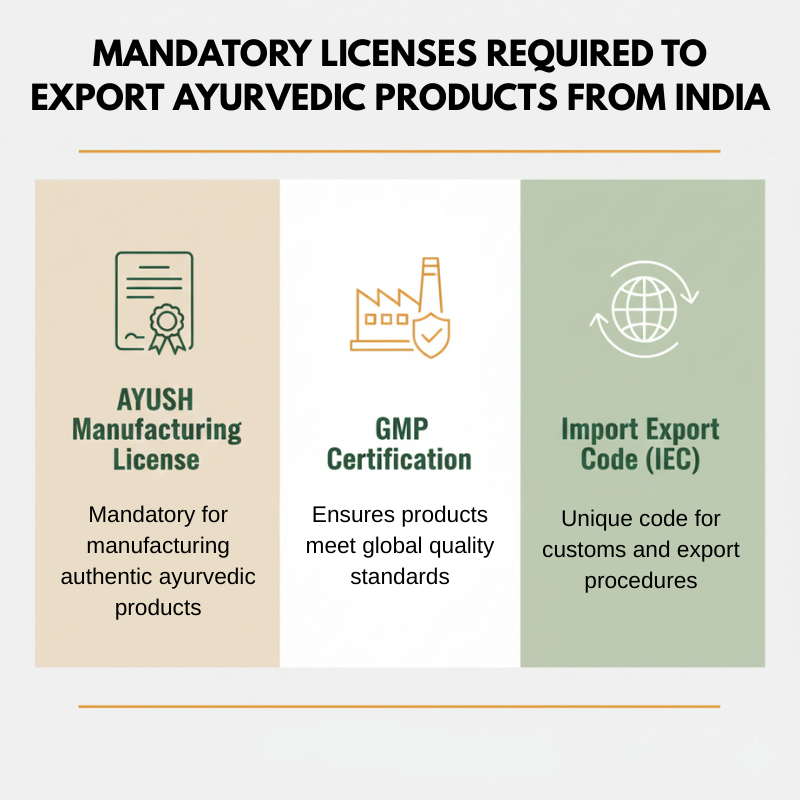
AYUSH Manufacturing License
An AYUSH manufacturing license is mandatory if the product is classified as an ayurvedic medicine or carries therapeutic claims. It is issued by State AYUSH authorities and validates the legal manufacture of the product.
GMP-Certification
GMP-certified ayurvedic manufacturer status is a baseline requirement for most international buyers. GMP demonstrates that products are manufactured under controlled conditions with documented processes, hygiene standards, and quality checks.
Import Export Code (IEC)
Issued by the Directorate General of Foreign Trade, IEC is a non-negotiable requirement for any exporter. Without it, no legal export activity can take place.
Need a GMP-certified Ayurvedic product manufacturer with export-ready documentation support?
Explore Sage Herbals’ manufacturing & private label services tailored for exporters.
Complete List of Documents Required to Export Ayurvedic Products from India
Manufacturing & Product Documents
These establish the legitimacy and formulation of the product. They usually include AYUSH approval where applicable, detailed product composition, and stability data supporting shelf life.
Quality & Compliance Documents
Quality documents prove that the product meets defined standards. Common documents include the GMP certificate, Certificate of Analysis, and Material Safety Data Sheet.
Export & Shipping Documents
These support the physical movement of goods and include a commercial invoice, a packing list, and a certificate of origin.
Managing multiple licenses, test reports, and country-specific approvals often leads to compliance gaps.
This step-by-step documentation guide helps exporters track responsibilities, timelines, and authority-wise requirements in one structured framework.
How Long Does the Documentation Process Take for Ayurvedic Export?
The documentation timeline to export Ayurvedic products from India depends on product type, classification, and target market. There is no single fixed timeline because some approvals are one-time, while others are product-specific or country-specific.
For Ayurvedic medicines, documentation can take longer due to AYUSH approvals, stability data preparation, and compliance checks. Herbal cosmetics and personal care products usually have a shorter documentation cycle but still require careful labeling and ingredient validation.
Which Document Is Required First for Ayurvedic Export?
The first document required to export Ayurvedic products from India is a correct product classification supported by manufacturing approval. Without precise classification, no other document holds value.
For Ayurvedic medicines, AYUSH manufacturing approval is the starting point. For herbal cosmetics, ingredient validation and formulation documentation are the priorities. An Import Export Code is also mandatory at an early stage because no export activity can proceed without it.
Starting documentation in the wrong order often leads to duplication, rejections, and increased compliance costs. A structured approach saves time and avoids regulatory errors.
Labeling Requirements for Exporting Ayurvedic Products
Labeling is one of the most underestimated risk areas in Ayurvedic exports. Many shipments fail due to incorrect or incomplete labels.
Mandatory label elements usually include product name, ingredient declaration, manufacturer details, batch number, and expiry date. Claim restrictions apply strictly, especially to products entering regulated markets such as the USA or the EU.
Indian domestic labels often differ significantly from international requirements. Using the same label without modification is a common cause of rejection.
Country-Specific Export Compliance (USA, EU, Middle East)
USA (FDA Considerations)
In the United States, product classification depends on claims and intended use. FDA registration requirements vary accordingly.. Some categories require facility registration, while others focus on product compliance.
EU Regulations
The European Union follows a structured compliance framework. Cosmetic products require CPNP registration and safety assessment by a qualified professional. Compliance is usually product-specific, not company-wide.
Middle East
Middle Eastern markets often require local authority registration, longer approval timelines, and, in some cases, halal documentation. Regulatory expectations differ by country, so pre-checks are essential.
Cost Range for Ayurvedic Export Documentation and Compliance
The cost of complying with export requirements for Ayurvedic products from India varies by product category, documentation depth, and target market. There is no fixed cost structure because some expenses are one-time, while others are product-wise or market-wise.
Costs generally include licensing, testing, stability studies, labeling updates, and country-specific registrations. Ayurvedic medicines usually involve higher compliance costs than herbal cosmetics due to stricter regulatory requirements.
Planning compliance costs early helps exporters avoid budget overruns and rushed documentation that increases the risk of rejection.
Private Label Ayurvedic Export from India
Private-label Ayurvedic manufacturing changes compliance responsibility and distribution. The brand owner is responsible for market claims and positioning, while the manufacturer must support testing, documentation, and regulatory alignment.
Manufacturer capability plays a critical role here. A weak manufacturer increases regulatory risk, regardless of brand strength.
How Sage Herbal Supports Global Ayurvedic Export?
Sage Herbal operates with a compliance-first manufacturing approach. The company has GMP, ISO, and FSSAI-certified facilities, supported by in-house R&D and testing laboratories.
Export-ready documentation support, private label capability, and regulatory alignment form the operational backbone. The focus remains on accuracy, traceability, and long-term regulatory credibility rather than marketing claims.
Connect with Sage Herbal to understand export documentation requirements, regulatory compliance, and manufacturing readiness for your target markets.
Frequently Asked Questions
1. Do we need an AYUSH license to export Ayurvedic products from India?
Yes. If we classify the product as an Ayurvedic medicine, we must obtain an AYUSH license before we export Ayurvedic products from India.
2. Is GMP mandatory for Ayurvedic export?
For most serious export markets and buyers, GMP certification is expected.
3. Can we export herbal cosmetic products from India?
Yes. We can export herbal cosmetics under cosmetic regulations, provided we follow proper labeling and compliance rules.
4. How long does Ayurvedic export registration take?
The timeline varies. We see different approval times based on product category and the regulations of the destination country.
Conclusion
Exporting Ayurvedic Products from India offers strong global potential, but success depends on correct documentation, product classification, and regulatory compliance. From mandatory licenses and labeling to country-specific rules, every step plays a role in avoiding delays and shipment rejection.
A compliance-first approach with a GMP-certified ayurvedic manufacturer helps manage export documentation, India requirements, and international herbal regulations with confidence. Proper planning reduces risk and supports long-term export growth.
Download the Complete Export Ayurvedic Products from India Documentation Guide(PDF)
This guide includes detailed workflows, authority-wise documentation responsibilities, labeling checklists, testing requirements, and country-specific compliance insights for serious exporters.
Please subscribe to our social channels for updates related to Ayurvedic skincare, research-based herbs, and wellness tips.
Instagram: Sage Herbals
Facebook: Sage Herbals
YouTube: Sage Herbals
LinkedIn: Sage Herbals Pvt.Ltd.
Leave a Reply
You must be logged in to post a comment.