
Are Indian brands underestimating the real cost of manufacturing before their first sale?
Setting up an Ayurvedic manufacturing unit in India generally requires a major investment before your first product reaches the market, often ranging from ₹50 lakh to ₹5 crore or more depending on scale, because the facility, machinery, and compliance costs add up quickly (Source: Industry setup estimates).
When brands evaluate Third Party Manufacturing vs In-House Manufacturing, both options demand investment. The real difference lies in when the money is spent, how much capital is committed upfront, and the level of risk the brand takes on..
Most online comparisons reduce this decision to basic numbers, but manufacturing choices don’t work that way. They depend on your business stage, compliance responsibility, and production planning, all tied into one critical decision.
This article breaks down real costs, hidden risks, and practical trade-offs so you can decide based on facts, not assumptions.
Third Party Manufacturing vs In-House Manufacturing: What It Actually Means in India ?
When brands talk about manufacturing, they usually refer to two models: third party manufacturing and in-house manufacturing. Many people misunderstand these terms and assume manufacturing is only about machines and production, but in regulated industries like Ayurveda, supplements, and cosmetics, the meaning goes much deeper.
Third party manufacturing means a brand gets its products made by an approved external manufacturer. The manufacturer already has the facility, machinery, AYUSH and FSSAI approvals, and compliance systems in place. They handle production, testing, documentation, audits, and regulatory processes, while the brand focuses on formulation decisions, packaging, marketing, and sales.
In-house manufacturing means the brand sets up and runs its own manufacturing unit. The brand manages everything directly, including facility setup, machinery, AYUSH licenses, FSSAI approvals, pollution permissions, fire NOCs, labor compliance, audits, inspections, and documentation. Along with production, the brand also maintains full-time teams such as production managers, quality controllers, warehouse staff, and maintenance technicians.
Both models involve structured processes, strict compliance, and ongoing operational responsibility. The difference lies in who owns and manages the manufacturing infrastructure and regulatory obligations on a day-to-day basis.
Why Choose Third Party Manufacturing Over In-House Manufacturing?
When brands evaluate Third Party Manufacturing vs In-House Manufacturing, the decision usually comes down to capital exposure, operational responsibility, and flexibility. In-house manufacturing demands heavy upfront investment and long-term fixed costs, while third party manufacturing allows brands to start, test, and scale production without building infrastructure.
The real cost difference between both models is clearly explained below.
Cost Breakdown: In-House Manufacturing
| Cost Area | In-House Manufacturing Details |
| Land or Long-Term Lease | ₹50 lakh to ₹2 crore for a compliant manufacturing space. Industrial zones near metros cost more, while remote areas reduce rent but increase logistics challenges. |
| Machinery & Validation | ₹1.5–3 crore for mixing tanks, filling lines, labeling machines, and testing equipment, plus ₹20–40 lakh for installation, calibration, and initial validation batches. |
| Compliance & Certification | AYUSH license, GMP certification, FSSAI, ISO (if required), pollution clearance, and fire safety approvals together cost ₹15–30 lakh and take 6–12 months. Renewals and audits add ongoing expenses. |
| Staffing | A team of 10–15 people across production, quality, packing, and maintenance costs ₹25–40 lakh annually. Skilled GMP professionals earn 30–40% higher salaries than non-regulated manufacturing roles. |
| Utilities, Downtime & Rejects | Power, water, fuel, and waste management add ₹3–6 lakh per month. Maintenance downtime, festive shutdowns, and learning-phase rejects further increase costs. |
| Total First-Year Cost | ₹3–8 crore depending on scale and location. Setting up an Ayurvedic manufacturing unit in India requires accounting for every layer, not just machinery. |
What Third Party Manufacturing Really Covers?

Third party manufacturing does not remove costs. It shifts them from upfront investment to batch-based spending.
Instead of investing in land, machinery, and licenses, brands pay per batch. The manufacturer absorbs capital expenditure, compliance management, staffing, and facility maintenance. Brands focus on formulation direction, packaging decisions, marketing, distribution, and sales.
What still stays with the brand includes formulation development unless provided by the manufacturer, packaging design, label approvals, marketing material, and inventory planning. Minimum order quantities can lock working capital if demand forecasting is inaccurate.
Third party manufacturing in India appears cost-effective upfront because manufacturers have already invested crores in setup. They recover these costs by serving multiple clients at high capacity, allowing brands to benefit from economies of scale without carrying the full risk. The trade-off is operational dependency on the manufacturer’s timelines, quality systems, and available capacity.
For brands that want this model to work smoothly, choosing the right manufacturing partner matters. Companies like Sage Herbals Pvt. Ltd. support brands with GMP-certified facilities, formulation development, testing, and compliance handling, making third party manufacturing easier to manage without building in-house infrastructure.
Cost Breakdown: Third Party Manufacturing in India
| Cost Area | Third Party Manufacturing Details |
| Per-Unit Pricing | ₹8–50 per unit for Ayurvedic syrups, tablets, or powders, depending on formulation complexity, pack size, and order volume. Higher MOQs reduce per-unit cost. |
| MOQ Requirements | Minimum batch sizes usually range from 5,000–10,000 units per SKU. Slow-moving products can lead to cash lock-in and expiry risk. |
| Packaging & Formulation Charges | Custom formulation development costs ₹50,000–2 lakh. Packaging components like bottles, cartons, and labels add ₹2–10 per unit. |
| Compliance Costs | Testing, documentation, GMP maintenance, and regulatory compliance are built into per-unit pricing, removing the need for an in-house regulatory team. |
| Total Cost for 10,000 Units | ₹2–5 lakh for a mid-complexity Ayurvedic product, including packaging and testing. Scaling up lowers per-unit cost, while smaller volumes reduce negotiation power. |
Because in-house manufacturing demands heavy upfront investment, long compliance timelines, fixed staffing costs, and ongoing operational risk, most brands find it capital-intensive and inflexible in the early stages.
Third party manufacturing avoids these burdens by offering batch-wise costs, built-in compliance, and faster scalability. For this reason, third party manufacturing is the smarter and more practical choice for most growing brands.
This cost structure works best when manufacturers already operate at scale. Established third party manufacturers like Sage Herbals Pvt. Ltd. spread compliance, testing, and operational costs across multiple brands, which helps keep per-unit pricing predictable and compliant for growing businesses.
Side-by-Side Cost Reality: In-House vs Third Party Manufacturing
Here’s a quick comparison of the factors that truly matter when evaluating third party vs in-house manufacturing.
Key Decision Factors
- Capital Lock-In: In-house manufacturing requires ₹3–8 crore upfront, while third party manufacturing only needs ₹2–10 lakh per SKU batch as working capital. For early-stage or bootstrapped brands, this gap can decide survival.
- Time to Market: In-house setup takes 8–18 months due to approvals, hiring, and validation. Third party manufacturing can start in 30–90 days, making speed a clear advantage in D2C markets.
- Compliance Risk: With in-house manufacturing, you handle every audit, renewal, and inspection. A single lapse can stop production. In third party manufacturing, the compliance burden stays with the manufacturer.
- Unit Economics at Low Volume: At around 10,000 units per month, third party manufacturing remains cost-efficient. In-house manufacturing starts making sense only beyond 1 lakh units per month with stable demand.
The contract manufacturing vs own factory decision should be driven by your current scale and risk capacity. If volumes are uncertain and capital needs protection, third party manufacturing is the practical choice. In-house manufacturing becomes relevant only when demand is stable, predictable, and large enough to absorb fixed costs.
When In-House Manufacturing Is a Practical Choice?
In-house manufacturing works best when a brand operates at a stable and predictable scale. If monthly volumes consistently cross 50,000 units across multiple SKUs, fixed costs like staff, utilities, and compliance get absorbed more efficiently.
It also suits brands with finalized formulations and minimal product changes. Running production internally gives better control over recipes and processes, but frequent experimentation can increase cost and complexity. In-house setups are more effective when customization or unique processes are critical to the product.
This model requires strong regulatory understanding. Teams must manage AYUSH, GMP, and FSSAI compliance independently. Without this maturity, audits and renewals can become operational risks. For brands with steady demand and long-term category focus, in-house manufacturing can offer control, but it demands commitment and discipline.
When Third Party Manufacturing Is the Right Choice?
Third party manufacturing suits brands that need speed, flexibility, and capital protection in the early and growth stages. It allows products to reach the market within weeks instead of months, making it easier to test demand without locking large funds into infrastructure.
This model limits operational exposure. Compliance management, audits, and quality systems stay with experienced manufacturers, reducing risk during uncertain demand phases. Production can scale up or down based on sales without adding fixed costs like staff or machinery.
Third party manufacturing also works well when brands explore new SKUs or categories. It keeps operations lean and focused on brand building and distribution. While it offers less direct control, it provides a practical balance between growth and financial discipline.
For brands exploring this route, working with an experienced manufacturer reduces early-stage risk. Sage Herbals Pvt. Ltd. helps startups and D2C brands launch Ayurvedic products faster by managing compliance, testing, and production under one roof.
Decision Framework: How Brands Make the Right Manufacturing Choice?
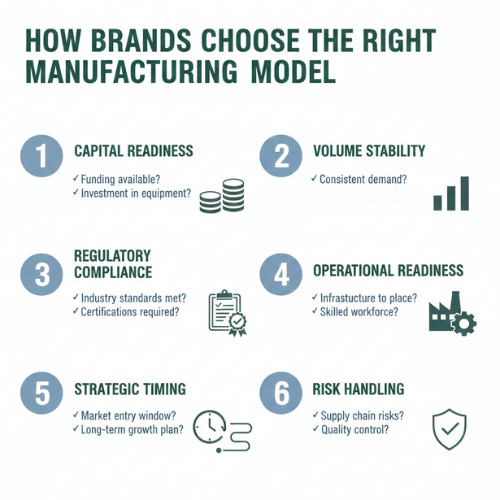
Use this checklist to decide between third party manufacturing vs in-house manufacturing. Answer these questions based on where your business stands today. This works only if you answer based on facts, not plans.
1. Capital & Financial Readiness
- Do you have ₹5+ crore available without disturbing daily business?
- Can your business run for 12–18 months without revenue from a new factory?
- Is your working capital enough for inventory, salaries, and utilities during setup?
2. Volume & Demand Stability
- Are you selling 30,000+ units every month across SKUs?
- Do you have at least 12 months of stable or growing sales data?
- Do your top 3 SKUs bring 70% or more of total revenue?
3. Regulatory & Compliance Readiness
- Do you have in-house knowledge of AYUSH, FSSAI, and GMP?
- Can your team handle audits, paperwork, and license renewals on its own?
- Have you managed compliance in any regulated industry before?
4. Operational Readiness
- Are your formulations final with very few changes?
- Do you have access to trained GMP production and quality staff?
- Can you manage machine maintenance, calibration, and downtime?
5. Strategic Timing
- Is speed less important than long-term margin control right now?
- Are you committed to this category for the next 5 years?
- Do your processes really need in-house control?
6. Risk Handling Ability
- Can your business survive a 6-month production stop?
- Can you afford idle factory costs if demand drops?
- Do you have backup plans for quality or machine failures?
How to Read Your Score?
- 0–4 YES answers
→ Third party manufacturing is the safer and smarter option.
- 5–8 YES answers
→ You’re in between. A hybrid or phased approach may work. - 9+ YES answers
→ In-house manufacturing can be considered with detailed planning.
Why Choose Sage Herbals?
When evaluating third party manufacturing vs in-house, execution matters as much as strategy. Sage Herbals Pvt. Ltd. offers GMP, ISO, and FSSAI-certified third party manufacturing with end-to-end support, from formulation and lab testing to production and customized packaging. This allows brands to scale without locking capital into factories or compliance teams.
If you’re planning your next move in third party manufacturing vs in-house, connecting with Sage Herbals can help you choose the right path with clarity and confidence.
Frequently Asked Questions
1. Which is cheaper for startups: third party manufacturing vs in-house manufacturing?
For startups and early-stage brands, third party manufacturing vs in-house manufacturing clearly favors third party manufacturing. In-house manufacturing needs ₹3–8 crore upfront and ongoing fixed costs, while third party manufacturing works on batch-wise pricing. This makes third party manufacturing more affordable, flexible, and safer when demand is still uncertain.
2. When should a brand switch from third party manufacturing to in-house manufacturing?
In the third party manufacturing vs in-house manufacturing decision, switching to in-house makes sense only when monthly volumes are stable above 50,000 units, formulations are finalized, and the brand can manage AYUSH, GMP, and FSSAI compliance independently. Until then, third party manufacturing helps brands scale without financial pressure.
3. Why do brands choose Sage Herbals for third party manufacturing instead of in-house manufacturing?
When comparing third party manufacturing vs in-house manufacturing, many brands choose Sage Herbals Pvt. Ltd. because it removes the need for heavy investment in factories, staff, and compliance. Sage Herbals provides GMP, ISO, and FSSAI-certified manufacturing, formulation support, testing, and customized packaging, allowing brands to launch and scale without building infrastructure.
4. Is third party manufacturing safe and compliant compared to in-house manufacturing?
Yes. In the third party manufacturing vs in-house manufacturing debate, third party manufacturing is safe when done with a certified partner. Companies like Sage Herbals Pvt. Ltd. follow strict GMP processes, regular audits, and regulatory testing. This often makes third party manufacturing more reliable than running an in-house setup without deep compliance experience.
Conclusion
The real decision in third party manufacturing vs in-house manufacturing is not about control or ambition. It is about timing, capital protection, and operational readiness. In-house manufacturing suits brands with stable demand, strong compliance capability, and long-term volume certainty. For most startups and growing brands, third party manufacturing offers lower risk, faster market entry, and flexible scaling.
Choosing the right model at the right stage protects cash flow, reduces compliance pressure, and allows brands to focus on product, distribution, and growth. Manufacturing success comes from alignment with business reality, not from building infrastructure too early.
Disclaimer
The cost figures, comparisons, and examples mentioned in this article are indicative industry estimates provided for informational and educational purposes only. Actual manufacturing costs may vary based on formulation complexity, order volume, packaging requirements, regulatory approvals, and market conditions. This article does not represent fixed pricing or commercial terms of Sage Herbals Pvt. Ltd. For accurate quotations, project feasibility, or manufacturing discussions, brands are advised to consult directly with the manufacturer.
Please subscribe to our social channels for updates related to Ayurvedic skincare, research-based herbs, and wellness tips.
Instagram: Sage Herbals
Facebook: Sage Herbals
YouTube: Sage Herbals
LinkedIn: Sage Herbals Pvt.Ltd.
Leave a Reply
You must be logged in to post a comment.